The days before a World Cup do something strange to anyone who has worked behind the scenes of one. You stop seeing a football tournament and start seeing the machine. Stadiums filling across eleven American cities, three host nations, players landing, fans travelling. Then you go one level up, into everything digital, and the picture turns into a set of bubbles all expanding at once. FIFA pushing content. Broadcasters pushing content. Rights holders, federations, teams, individual players, and now creators, all pushing live and not-live content into a space where billions of people are waiting to watch, react, clip, argue and share.
I designed the match schedule page on FIFA’s website with my team somewhere between eight and twelve years ago. It is still there, still doing its job. I mention it because that page was built for a simpler question. A fan opened it to find out when a game kicked off and which channel carried it. One screen, one answer.
That question now has dozens of answers, and the gap between then and now is the real story of this tournament. 104 matches across 39 days is the largest live content event ever staged, and it arrives at the exact moment the industry has finished rebuilding how live sport reaches people. The World Cup is where all of it goes live at once, in front of the whole planet.
Here are 5 trends in live sports streaming worth watching while you watch.
1. One match, many ways to watch
For most of the tournament’s history, watching the World Cup meant one product: the world feed, on a screen, possibly with a highlights show after. The director chose the shot, you received it, and that was the experience. It worked, and it still anchors the audience. The Final will be the most watched single event on the planet this year, most of it on television.
What changed is everything around that anchor. The same match now ships in parallel versions, and the fan picks the one they want.
The clearest example is sitting on BBC Sport right now. The BBC has launched a World Cup 3D Experience, a real-time rendered version of the match built on the visual language of a video game engine. Real data, real positions, in real time and replay. You can watch from any angle, take a full-pitch tactical view, follow a single player across the pitch, or drop into the eyes of the scorer as the ball goes in. One reviewer described watching Brazil’s goal against Morocco from the first-person perspective of the player who scored it, the match turned into something you read the way you read a game. It runs on a second screen alongside the television broadcast, the second-screen experience broadcasters have chased for years, except this one offers something genuinely new, and it needs no VR headset, which puts it within reach of any fan with a phone. The BBC’s own editor framed it as a question about the future: whether kids find this more engaging than a traditional broadcast, whether coaches use it for tactical analysis, whether this is simply where the game is heading.
DAZN, carrying all 104 matches in Italy, Spain and Japan, opens its app directly into an interactive mode ahead of any plain video player. Multiview lets a viewer run up to four matches on one screen. In Japan, fans vote to choose which players get dedicated camera feeds, and a four-angle mode offers a player camera from each team. The default has moved. The old flow asked you to turn a lean-back broadcast into something interactive. The new one starts interactive and lets you lean back if you choose.
Across these versions sits a Serie A signal I picked up in June at the Festival della Serie A in Parma, where I spent the better part of two days on data and broadcast panels. The league is preparing to stop producing a single multilateral feed and start producing a package: the clean feed, an augmented feed dense with live graphics, and a recreation feed aimed at younger fans. The reference point here is what real-time visualisation has built with the NFL and ESPN in the US. A visualisation engine turns live player-tracking data into a fully animated version of the match as it happens, from the Nickelodeon and Toy Story Funday Football altcasts to the Simpsons and Monsters editions, drawing some of the biggest live audiences ever recorded on Disney+ and ESPN+. The same match, recreated as a video game in real time, has gone from novelty to a fixture of the broadcast calendar in three seasons. The live AR feed I saw demonstrated on my panel overlays expected goals, distances and momentum and renders a gamified 3D player map in under three seconds. It goes live with broadcasters at this World Cup. Serie A is in conversation with DAZN to take its version to market.
One match, many feeds. The viewer composes the experience. That is the first trend, and it sets up everything that follows, because a catalogue of parallel feeds only works if something underneath can serve them all at the same quality and let a fan switch between them instantly without a stall or a spinner. The feed menu is a product promise. The player is what keeps it.

2. Watching became engaging, and engaging became the point
Ask how someone is following the World Cup and “watching” only half-answers it. They are also voting, chatting, predicting, posting and arguing, often on the same screen as the match and often inside the same app.
DAZN’s FanZone runs live chat, polls, quizzes and games during matches, and lets fans interact with each other and with players through the app. I have lived the rough edges of this first hand as a user, the fan chat that lags or floods or falls over at the exact moment everyone wants to react to a goal, and that friction is the tell. Real-time social layered on top of live video is hard to build, because the chat and the game have to stay in sync and the whole thing has to survive a million people reacting in the same three seconds. When it works it disappears. When it breaks it takes the moment with it.
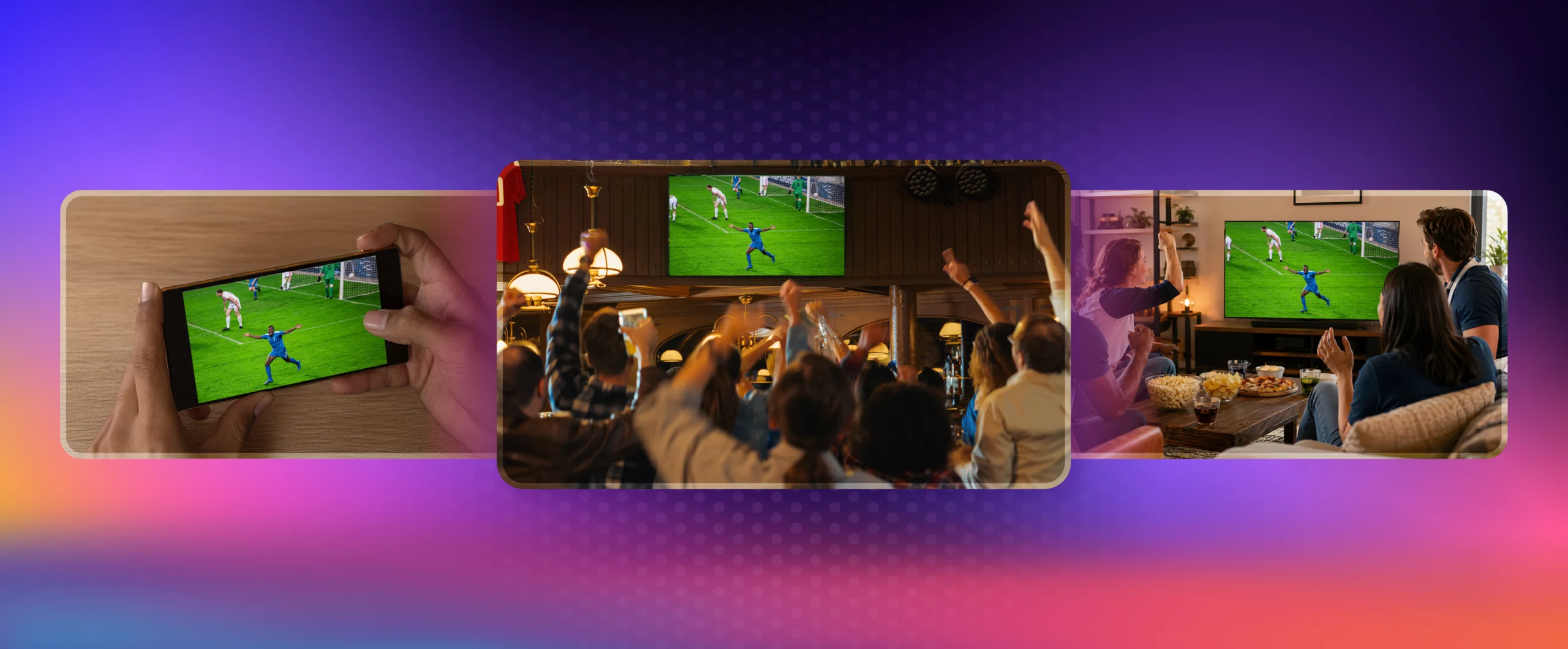
The watch party is the analogue version of the same instinct, and FIFA has industrialised it. Fan Festivals run in the host cities with stadium-sized screens for the millions who will never get a ticket. In Italy, a bar can buy a public-screening licence and turn a match into an evening that fills tables. The European café full of people watching one screen together proves the durable thing: the urge to experience the game collectively is the strongest force in this market. Every digital watch party, every FanZone, every group chat is a try at moving that feeling onto a phone.
Fan engagement carries real commercial weight. For a streaming platform it decides whether a viewer watches one match and leaves or stays for the tournament. It is also, quietly, the thing that turns a stream into a place a fan wants to be. Building it means carrying interactive data, social feeds and the video itself together, in sync, at scale, with the interactive layer never knocking the picture off its stride. The platforms that get this right will not call it engagement technology. Fans will just feel that their stream is alive.
3. The feed got faster, and latency became a feature you can sell
A live sports experience falls apart the moment the people around you know the score before your screen does. The neighbour’s roar through the wall, the goal alert on your phone, the group chat erupting eight seconds early. Every interactive and social feature in trends one and two depends on closing that gap, and this is the World Cup where the industry started selling the gap as a feature.
Sky’s Real Time, shipped for this tournament on Sky Glass and Sky Stream, is the visible example. It uses Low Latency HLS to cut end-to-end delay from around thirty seconds to roughly eight. The packager slices the stream into fractional-second partial segments instead of waiting for a full chunk, the player request is held open server-side so data fires the instant it is ready, and the result is a goal reaching you about eight seconds after it happens rather than half a minute later. Sky extended it to BBC and ITV channels through its platform, with the trade-offs stated plainly: you need the bandwidth, and live rewind goes away because the buffer has to stay tight.
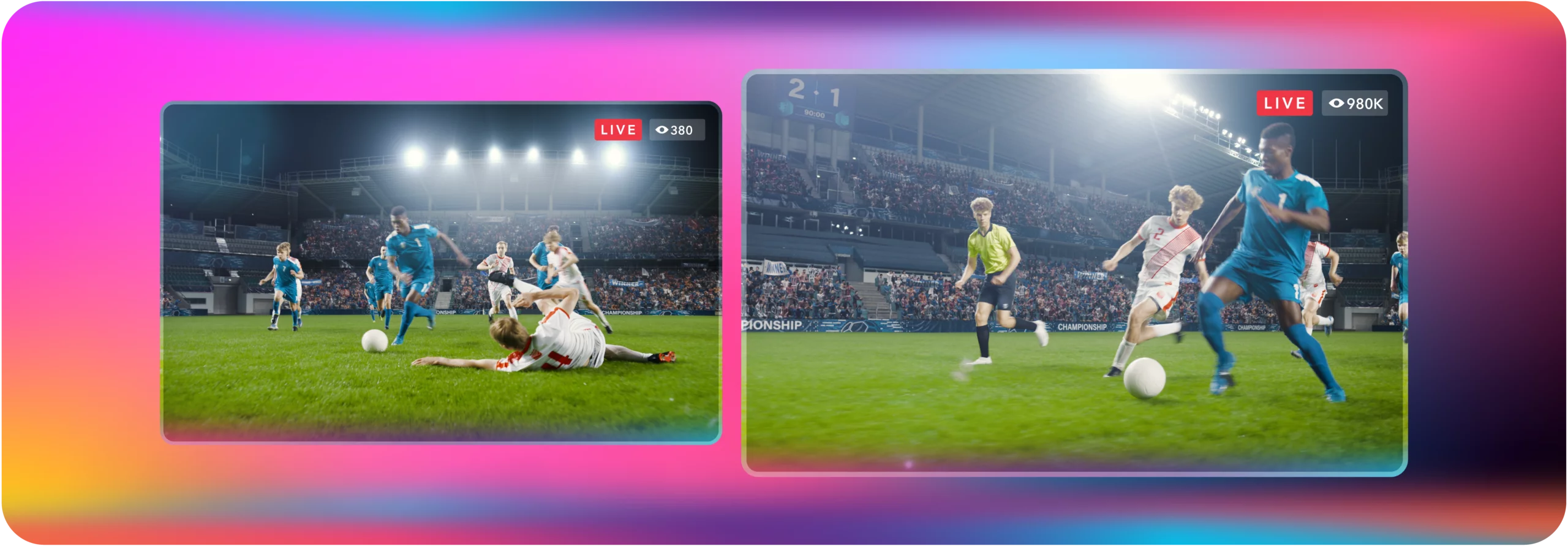
Latency stopped being plumbing and became positioning, and two kinds of it matter now. Raw speed closes the gap between the pitch and your screen. Consistent latency keeps every feed in step with the others, and that synchronisation is the foundation multiview stands on, because two windows running seconds apart break the whole illusion.
4. Many ways to watch means many ways to monetize
A tournament that ships in this many forms also gets paid for in this many forms, and the World Cup is running every model at once.
The subscription decade taught streaming to sell completeness. All 104 matches, one price, the proposition Fox One, DAZN, Magenta in Germany and ViX in Mexico all put forward. Around it, advertising-supported live has reached a scale the format has never had. CazéTV carries the entire tournament free on YouTube in Brazil, a creator channel holding tier-one rights. Tubi streams matches for free in the US. Peacock opens a free window at the start. Across markets, free-to-air packages act as the funnel that feeds the paid completionist tier above them. Free viewing is now the widest part of the audience and a serious business in its own right.
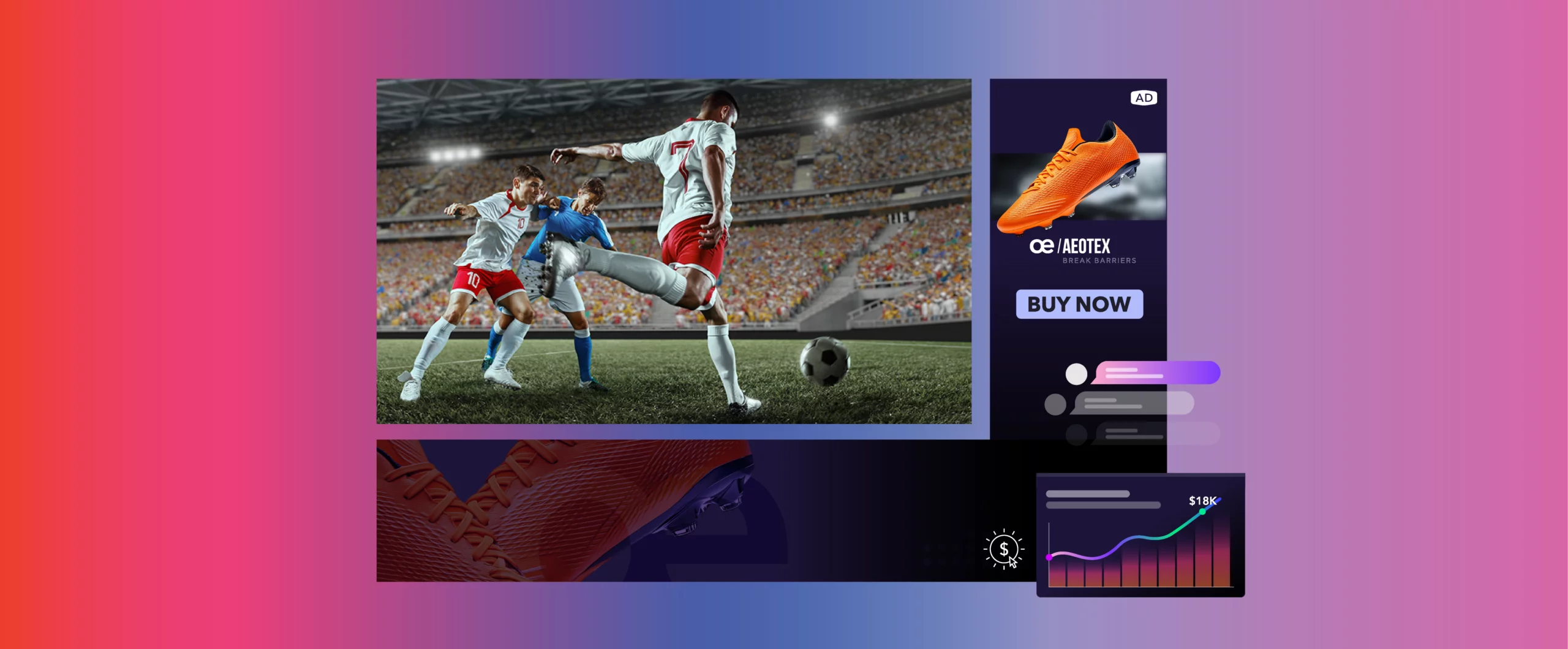
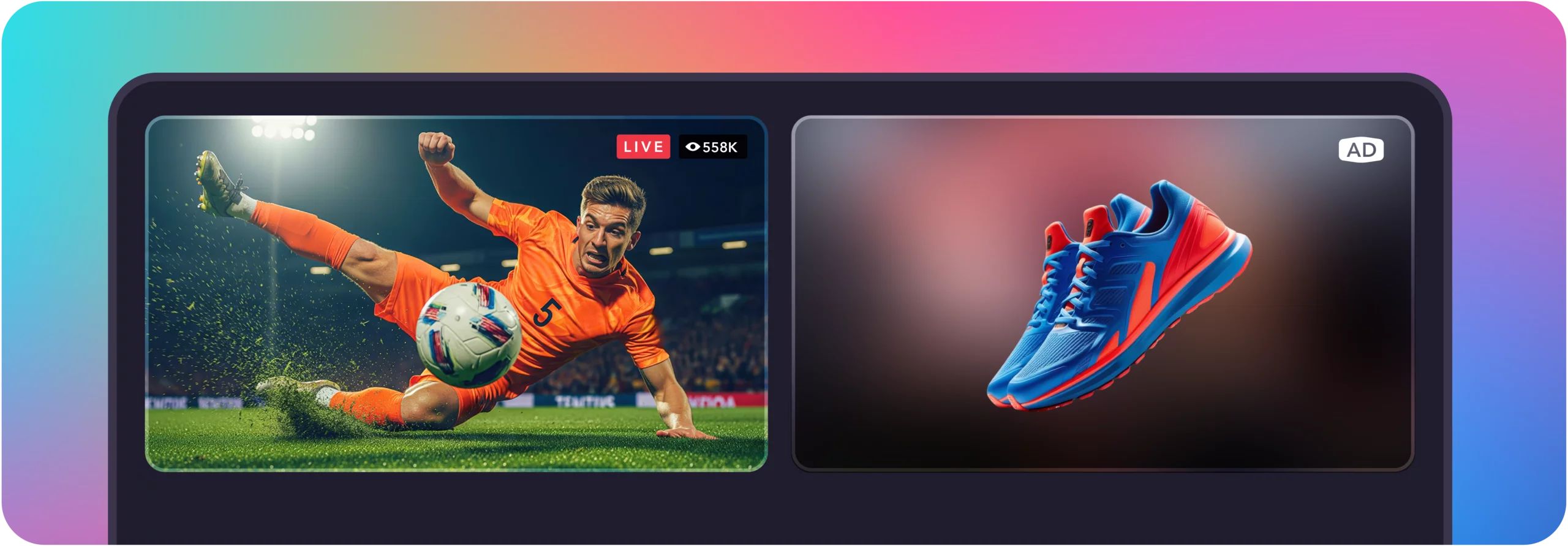
The newer move changes what an ad break even is. Live advertising is shifting from one spot shown to everyone toward a decision made for each viewer, and the enabling change is happening in the insertion layer. The current approach lets the server signal where an ad can sit while the player resolves which one to show for that specific session, holding broadcast-smooth playback even as millions watch at once. It is the same idea as the parallel feeds in trend one, applied to advertising: one stream, many personalised versions. It also opens the formats live football tolerates, the side-by-side, L-shaped and overlay placements that run next to play rather than interrupting it. Football never stops for ninety minutes, so the ad has to live alongside the match, and once it can, every moment becomes possible inventory rather than waiting for a whistle. Fox One’s configurable on-screen stats bar shows that exact screen logic is already becoming normal in the viewing experience.
The economics are simple to state and hard to build. Every format on the menu multiplies the number of sessions. Every session is now an addressable opportunity. The platforms that can serve a personalised ad as cleanly as they serve a personalised feed, at tournament concurrency, hold the strongest commercial argument heading into the next rights cycle.
5. The platforms own the destination, and the foundation decides who wins
Step back from the individual features and a pattern shows up. The fan’s attention is being gathered into destinations, and whoever owns the destination owns the relationship.
Meta made the clearest play this week. Search the World Cup on Instagram, or tap the tournament button on any football video, and you land in a curated hub: top Reels, Stories, broadcaster clips, fan posts, all in one place. Football Mode on Facebook, live match updates inside Messenger group chats, legend commentary on Threads. A fan can follow the entire tournament without opening a single federation site, broadcaster app or club channel. Meta is assembling the whole matchday inside its own walls.
For governing bodies, broadcasters and clubs, presence on these platforms is mandatory, because that is where attention pools. Reach on someone else’s platform stays on rented ground. When the platform owns the destination, the data and the fan relationship, everyone else is reduced to a content supplier filling a shop window. The content teams that win this World Cup will treat Meta’s hubs as exactly that, a window, and give fans a reason to walk through the door to a destination they own: better access, deeper content, a real community.
Owning the destination is the strategic prize, and the foundation underneath is what makes it defensible. A destination fans choose over Meta’s hub has to deliver the parallel feeds of trend one, the live interactivity of trend two, the closed latency gap of trend three and the personalised monetisation of trend four, all at once, all in sync, all at the scale of the biggest event on earth, and it has to feel effortless while doing it. That is a serious technical proposition. A streaming stack that carries video, interactivity, low latency and addressable advertising as one integrated system separates a platform fans return to from one that merely held the rights this time.
This is the quiet truth under all five trends. The visible story of this World Cup is about fan experience: the 3D views, the multiviews, the watch parties, the hubs. Underneath, none of it stands up without a foundation strong enough to hold it live, in sync, at planetary scale. Get the foundation right and the experiences feel like magic. Get it wrong and the magic stalls, buffers, and arrives eight seconds late while the neighbours are already celebrating.
The 5 trends, and the one reason underneath them
Pull the five together and the shape is clear. The match is no longer one thing; it ships in parallel feeds and the fan composes the version they want. Watching turned into taking part, with voting, chat and prediction sitting on the same screen as the action. Latency became a feature platforms sell, because speed and synchronisation are what make every other feature hold together. Many ways to watch opened many ways to monetise, with the ad break dissolving into advertising that runs alongside play. And the whole contest now turns on who owns the destination, the place a fan chooses when every platform wants to be their home for the tournament.
Under all five sits the same engineering truth. None of it holds up without a foundation strong enough to carry video, interactivity, low latency and personalised advertising at once, live, in sync, at the scale of the biggest event on earth. Get that right and the experiences feel like magic. Get it wrong and the magic stalls, buffers, and arrives eight seconds late while the neighbours are already celebrating.
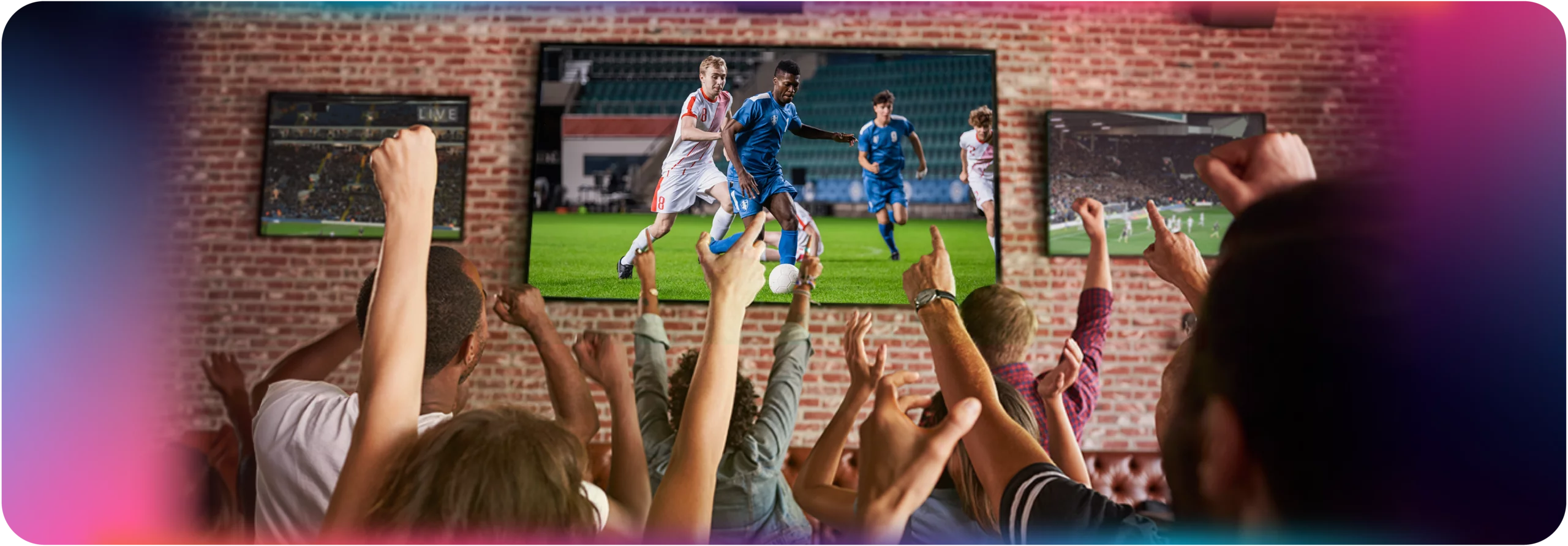
Here is the part the technology can forget. None of these trends exist for their own sake. People do not watch live sport for the multiview or the data overlay or the 3D camera. They watch because a match is a story told in real time with an ending nobody knows yet, and because watching it as it happens means feeling it at the same moment as millions of other people. The goal you see live, you see with everyone. The roar through the wall, the group chat erupting, the café going up at once, all of it is the same human need that filled stadiums a hundred years ago. Every trend in this piece is a new way to serve that need. The parallel feeds let you watch your way. The interactivity lets you react out loud. The closed latency gap means you feel the goal with the world the instant it happens. The personalized ad pays for the stream without breaking the spell. The destination is where the community gathers.
My son Miles is eleven. He plays football on a pitch in Turin and the rest of it on a screen, and he wants to know why the live feed and his EA FC game do not just talk to each other. He is trying to beat me at FIFA fantasy for the World Cup (incredibly not for now). He wanted to have Fantasy point live on the screen when he watched the game and send a clip of the action when that happens to his friends for fun. For these kids the pitch, the screen and the game are one football seen three ways. The wall between the live feed and the video game looks to them like a bug, and they are the fans who will fill the next thirty years of rights deals.
That is the test for everyone building these viewer experiences. Technology that deepens the shared moment will last. Technology that gets between the fan and the feeling gets switched off, however clever it is. The World Cup ships as a portfolio of products this summer, and running a portfolio is a different business from running a channel. The platforms that remember what fans come for, and build the foundation that delivers it, are the ones still standing when the next rights cycle opens. The rest will have shipped a lot of features and missed the match.
Sources
- BBC Sport, FIFA World Cup 3D Experience with Immersiv.io and BBC Media Tech (Andrew Haigh announcement)
- DAZN, enhanced in-app World Cup experience for Spain, Italy and Japan (Multiview, FanZone, fan voting, four-angle mode) — https://lnkd.in/de2gMv8c
- Sky, “Real Time” Low Latency HLS for Sky Glass and Sky Stream — https://lnkd.in/eMiCF2N3
- Meta, World Cup hub inside Instagram search, Football Mode, Messenger and Threads features — https://lnkd.in/eka_W6x9
- Carlo De Marchis, “Media Operations, Broadcast and Digital” — coverage of the Festival della Serie A data and broadcast panels, Parma, June 2026 (A Guy With A Scarf) — https://aguywithascarf.substack.com/p/media-operations-broadcast-and-digital
- Carlo De Marchis, “Football Through Their Eyes: A Multidimensional Experience” — field interviews with three young players in Turin (A Guy With A Scarf) — https://aguywithascarf.substack.com/p/football-through-their-eyes-a-multidimentional
- Sony Beyond Sports / ESPN, real-time animated alternate NFL telecasts (Toy Story, Simpsons, Monsters Funday Football) — https://www.beyondsports.nl/news/sonys-beyond-sports-and-espn-expand-collaboration-to-bring-additional-animated-telecasts-to-nfl-nhl-nba-and-wnba-fans-in-202526-season-starting-with-monsters-funday-football
- TheWrap, “How Fox One Is Preparing for the 2026 FIFA World Cup” — https://www.thewrap.com/media-platforms/streaming/fox-one-fifa-world-cup-product-updates-amit-dudakia-interview/
- Sports Video Group, Peacock launches Visión de Campo, all 104 matches in Spanish — https://www.sportsvideo.org/2026/05/06/fifa-world-cup-2026-peacock-launches-vision-de-campo-aka-pitchside-live-will-stream-all-104-matches-in-spanish/
- AP, CazéTV to stream all 104 matches free on YouTube in Brazil — https://www.boston25news.com/news/business/fifa-entices-new/7SOP2FKEEMY4JJZ56EVU4SSOQE/
- Al Jazeera, World Cup 2026 broadcast innovation, 3D player avatars and match ball sensors — https://www.aljazeera.com/sports/2026/6/6/fifa-world-cup-2026-what-is-new-sensor-match-ball-ai-player-avatar
- Dolby Optiview, What is SGAI (Server-Guided Ad Insertion) in streaming? – https://optiview.dolby.com/resources/blog/advertising/what-is-sgai-server-guided-ad-insertion-in-streaming/