Watch the session replay
Overview
How do you deliver streaming experiences that keep up with the speed and intensity of live sports—from the green flag to the checkered flag?
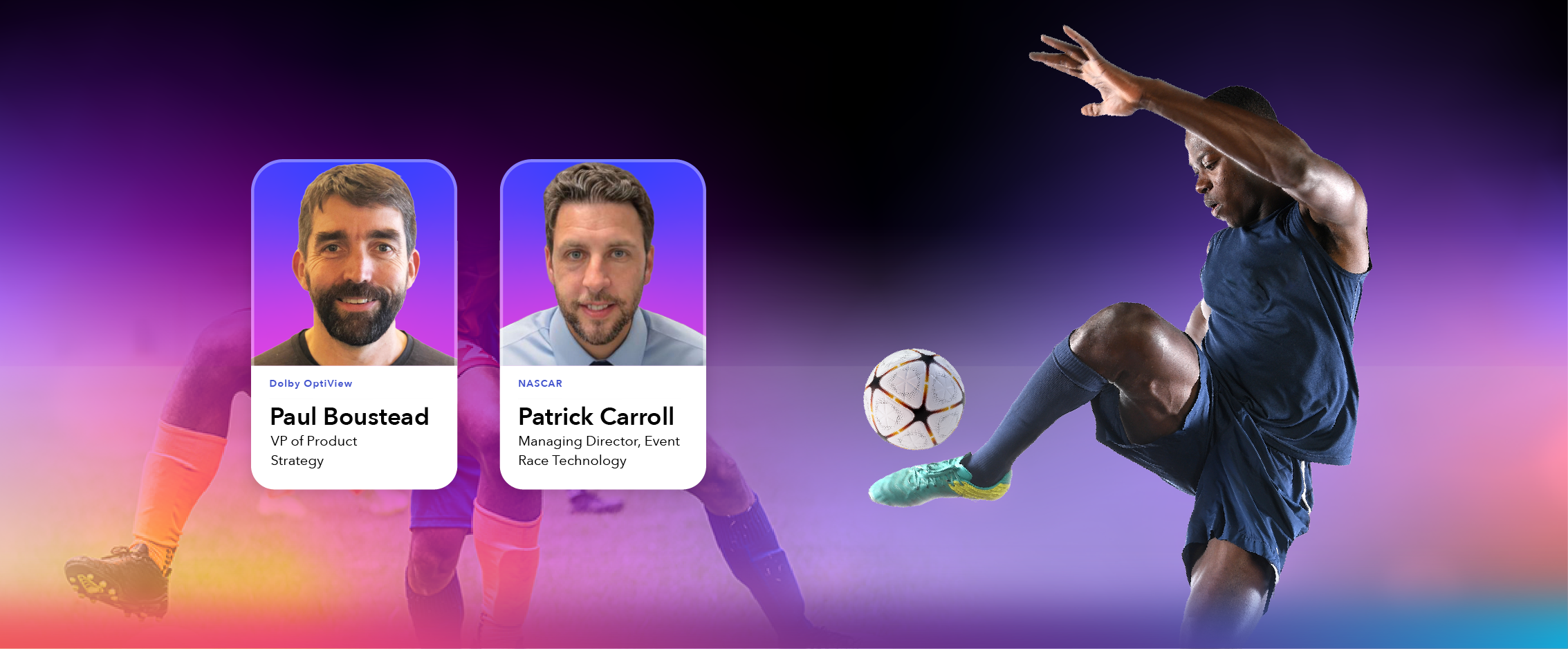
In this NAB Show Streaming Summit session, Patrick Carroll (NASCAR) and Paul Boustead (Dolby OptiView) explore what it takes to consistently deliver seamless, high-quality video experiences in fast-paced, mission-critical environments.
The discussion highlights how NASCAR and Dolby OptiView are pushing the boundaries of live streaming through ultra-low latency video and real-time personalization—empowering both fans and teams with more responsive, immersive experiences.
Featured speakers
Paul Boustead (VP, Cloud Product Strategy @ Dolby OptiView): Paul Boustead leads the cloud product strategy for Dolby OptiView. With over 17 years at Dolby, he has advanced video streaming technologies across live sports, gaming, and entertainment. Paul founded Spatial Voice, acquired by Dolby in 2007. His expertise includes WebRTC, SIP/RTP, real-time streaming, and advertising technology. Paul holds a Ph.D. in Telecommunications from the University of Wollongong and is passionate about innovation in audio and video technologies.
Patrick Carroll (Managing Director, Digital Technology @ NASCAR): Originally hailing from Ireland, Patrick Carroll currently serves as the Managing Director of Digital Technology at NASCAR, where he spearheads the digital technology strategy and leads a comprehensive team skilled in Web and Mobile App Development, Design, Project Management, and Quality Assurance. With a Bachelor of Science in Web Development and Technology, Carroll has dedicated his career to crafting front-facing digital products, ensuring that every innovation not only meets but exceeds industry standards. Under his guidance, his team continuously strives to transform digital interactions through focusing on fan and user experiences through state-of-the-art technology solutions.
Transcript
00:00:01 — 00:01:33
So I love working with NASCAR that it’s really exciting working with NASCAR. So, my name is Paul Boustead. I’m the VP of product strategy at Dolby on the Dolby OptiView product range. And today we’re going to spend 20 minutes because, we’re not going to compete with drinks. We’re going to spend 20 minutes talking about the work that we’re doing together.
So we’ll start with talking about the track app, where I’ll leave that to Patrick to describe, and then we’re going to talk about the learnings of how we’ve worked together. And then we’re going to talk a bit about the future of personalized experiences in motorsports. Before I get Patrick to introduce himself, I just want to give a little bit of background to Dolby in this space.
So, people know. So, Dolby is focusing a lot on sports at the moment because live sports is an amazing experience and Dolby is really an experience company and our history, we’ve been working with Hollywood to help them tell better story through technologies like Dolby Atmos and Dolby Vision. And so in sports, we’re applying these technologies to live sports experiences.
But in Dolby OptiView, we are working on creating truly personal experiences driven by an understanding of the engagement of the fan. So yeah, it’s a really exciting industry to work in. So I’ll pass over to Patrick now to talk about, introduce himself and, talk a little bit about NASCAR. Yeah. Thank you.
00:01:33-00:04:00
I’m the managing director of technology for NASCAR. I’ve been with the company going on 11 years. I’m supposed to say I’m between you guys and drinks, but I think you guys are between me and drinks, for being honest. So going a long way back started with NASCAR purely in the digital arm, and, last couple years, I switched over to the event technology side.
The biggest difference there is on the digital side, we really focus on post-race, on video content. We don’t stream NASCAR races on nascar.com. That goes to broadcasters. But on the event technology side, we have in venue mobile applications that allow us to be within a geofence and stream content live to fan. So we get to play in both worlds.
We were introduced to Dolby on the VOD side using their player, looking for a more modern advanced player than the player we had at the time about 4 or 5 years ago. Dolby’s player had a lot of integrations we needed from ad tech to analytics to just all of the observability and the ability for us to be able to stream our third party encoded content into their player seamlessly and within, I think 6 to 8 months rolled out the entire 50 plus of our ecosystem of sites to with Dolby Player, which is great. And from there rolled over to the NASCAR tracks app, which is essentially the one that’s geo fenced within the events to switch into the live space.
One thing I really like about the NASCAR track app is being able to actually hear the audio from the cars. Can you explain a bit about that? Yeah. So for those not aware, we essentially have two main products that fans get to use, which is a scanner app, which is that the communications between the driver and their their crew chief in the pit lane so you can, as a fan, listen to them communicating back and forth between between pit road and the car.
And then we have an in-car camera product, which is essentially you being inside the car with the driver of your choice. So you can do both things. You can listen to a driver’s communication, you can watch a driver’s point of view. Historically, they were all separate, so timing was different. The products were different, and you couldn’t watch them as a combined product.
So you can either listen to Driver A’s, audio, or you could watch Driver A’s in-car camera, or you could hack it together and make two tabs, but they weren’t in sync, which made it a bit of a difficult experience.
Yeah, having them in sync, I suspect, would have made the experience a lot better.
00:04:00:00-00:05:55:10
So how are the fans using the video experience and audio experience together?
So bringing in OptiView, it allowed us to work with the team, in our TV compound to figure out how to set up the product and solve the challenge all in one go, which was essentially to transcode both products into one output at the track and then deliver that to cloud. So instead of delivering them both out separately and then piecing them back together and having differences in time codes and difference in delivery, for that moment in the race, sending them out of track combined at the same moment in time, and then also tackling as I mentioned, this is the app fans are using while they’re sitting in the grandstands.
So it’s really really important what they’re hearing, what they’re seeing is real time. So we went from delivering video feeds and audio feeds that were 20 to 30s delayed, which is actually in line with broadcast. So it suited the needs to needing to find something that will allow somebody to watch the in-car cameras from their seats and look up from the phone and see it happened right in front of them.
And that’s when working with Dolby allowed us to get our latency down from 20 and 30s to under a second, which was our best case when we tried this out. And that was really great. We were working, though, we’re using a player for the website for playing videos, and then it was a quick seamless transition for us to go from that to actually streaming video in their app.
For people in on venue, we’ve done this with a number of organizations actually streaming live in venue. And in that case, latency is really important. You’ve got to have it to the level that you it’s not completely disconnected from the physical world. So it’s a great experience if you can be on the track and not only see the car drive past you, your favorite driver, but see it when it’s on the other side of the track itself.
00:05:52 — 00:10:40
Yeah, I think the Dolby sales team hated me because they sold us the player and then I sold them a problem, which was how do we merge two products into one? But we were able to solve it and deliver that out. And I think one of the biggest challenges we had with that was just on the user experience side, NASCAR tracks aren’t always in the middle of the best connected areas, and Wi-Fi can bottleneck a lot of time.
So if we try to be on the edge, we will deliver an experience that people see buffering more often than not, which causes them to leave the product. So while we could get probably sub-1 1.5 seconds from real-time. We made a decision to put about another second on that just to allow for that bandwidth bottlenecking issue to not be an issue causing fan to see the player buffering all the time.
So if we try to be on the edge, we will deliver an experience that people see buffering more often than not, which causes them to leave the product. So while we could get probably sub-1 1.5 seconds from real-time. We made a decision to put about another second on that just to allow for that bandwidth bottlenecking issue to not be an issue causing fan to see the player buffering all the time.
Once we pushed that out a little bit, which is fully configurable. One thing, your systems which is great for us because the NASCAR Chicago race that you guys saw in the promo is in the middle of downtown Chicago. Internet connectivity and cell signal is fantastic. So we can have a little bit better latency there, if we’re in the middle of nowhere, and in a lot of NASCAR tracks with a configuration change in the admin, we can go in and add a little bit of buffer there, which allows the experience to maintain its level of neatness.
How was the deployment?
So it’s exactly what you said which which sounds like I’m selling Dolby in more than I should. But it was, it was I think adding two properties to the player config to switch into live and and if we didn’t have to solve the the remote production of, or sorry, the At-track production of a remote product, two-in-one, I think we would have probably been able to switch to OptiView in a week.
But because we had to go to multiple tracks and try multiple different versions of merging these products, so it was probably a few months. Well, that’s good that it didn’t want it to sound like a sales pitch with that question, but it, so there were, yeah, we did work with them on issues to make sure that it goes well and we work with them closely.
And that’s actually the team were actually excited to go out on the track with them and actually learn, while we are working together. So, unfortunately I wasn’t, but I am going to go to one race pretty soon. I’m going to make sure I do that. They’re always looking for problems where they need to travel to and, That’s right!
So, I understand that the teams are quite interested in using it as well, not just yeah, you how, how are they using it? That’s one of my favorite use cases is we deliver this for fans in venue to kind of be able to augment their experience and watching it. And we found that our race teams and our OEMs had a real use case for this product as well, which was a lot of their engineers and their strategists are at the event, but a lot of them are at home in their war rooms.
And traditionally they were using the legacy feeds, which are 20- 30s delayed, like I said, match with broadcast, which doesn’t really help you for for strategy, right. If you’re trying to help people at the track make a decision in real time and you’re 20s behind, it’s a bit of a problem. So when they got a hold of the low latency video product, they started requesting access to it, and we built an entire internal strategy product for the teams in OEMs to use this and have heard nothing but amazing things about the decisions they’re able to make.
Now, down to just listening to engine noises in real time, listening to driver communications from Charlotte. If the race is all the way in Vegas and having no delay in doing so. So that was great.
And I understand you’ve moved on to a different part of the organization since you’re working on the digital properties. Can you talk a bit about that? Because the area which is super interesting to me on the data side.
Yeah, we’re streaming. We’re streaming millions of data points from the car in real time, we’re getting data of the car at 10 hertz. We’re getting 10 messages a second, it miles per hour. That’s engine speed, throttle, steering angle, brake pressure, all the way to GPS within 10 centimeters of accuracy to timing and scoring loops, which is essentially transponders in the car, pinging loops around the track and getting car position, whether the high and low on the track they’re heading, their velocity, everything in between.
So that’s products that we can deliver out to broadcasters, that’s products we can deliver to the teams and the OEMs for race strategy decisions as products we can give to our digital partners to build leaderboards and everything in between. So they have, you know, real time maps with cars going around. We call bubbles and showing the real time miles per hour of whatever driver they’re favoriting and watching.
So my job used to be to consume that data on the digital side and switched over roles to the event side of the business in event tech. And my job then became ensuring that data left the track and got out to all the consumers.
00:10:40 – 00:16:47
And this is actually a good segue to what we want to talk about next, which is future experiences for motorsports, not necessarily NASCAR, but what are the problems that create experiences within motorsport?
And also I’ll start off by talking a little bit about our experience. So motorsports has got unique challenges for engagement and experiences. It’s a produced feed follows a number of cars around the track and switches between cameras, and it shows one story that’s happening on the field or switches between stories. And so that’s one view, which is the view for a generic audience. However, with motor racing, there’s many cars on the track and they’re not within the camera view.
So one thing that’s really interesting to us is, can we create experiences where people can watch what they want to watch? And there are a couple of options here. One is to just enable the viewer to look at all of the camera angles. So which is in the tracks app. So a very engaged viewer can flick through the camera angles, follow the car that they’re interested in, swap between track and car cameras.
However the person has to engage themselves. So one thing at Dolby we really see is how do we enable a personalized fan experience in motorsports that actually produces a feed for the viewer to keep them watching in a lean back way, so not actually having to engage themselves. But can we use an understanding of that viewer, to give them a lean back experience which keeps them watching?
And for that the data side is is hugely important. Understanding what’s happening on the racetrack really helps you try and create those experiences and some understanding of the user as well. What are your thoughts on the future of motorsports? Online experiences?
Yeah, I 100% agree. I think the feedback we get from fans a lot of time is, you know, the broadcasters storyline that they’re following might not match up with the fans favorite driver, who may not be in the middle of an intense battle at the moment. So they’re out of broadcast view. And that fan is really wanting to digest that content.
And I think the statement that I like the most is today we generate one feed for 50,000 people where I think we’re going to work slower will generate 50,000 feeds for one person. So I think we’ll get there pretty soon in the next probably 24 months, where you will have very personalized, tailored broadcast quality versions of an event that is just for you.
Yeah. And that’s a big concentration with us at Dolby. And we got a number of demos at the booth, so I won’t talk more about it than that. But if you’re interested in personalization, which is driven by the fans engagement as opposed to just creating experiences where the fan has to engage themselves. So actually creating a personal director experience, that’s something that we’re pretty engaged in at Dolby.
So what’s next for you with NASCAR? AI. Yeah. Everything we, we talk about today is driven by how can we personalize to an individual fan, which always feeds itself to AI. We have so much data that we have at our disposal about, you know, fan segments to real time race data. And that’s where we need to focus our efforts is how do we pair that with video and audio, the real time raw data, and make it so that the casual fan can come to a NASCAR event and feel as as informed?
As an avid fan, how do we tell a story to the left side of the room in a way that they get ends in the right side of the room in the way that they get without anybody feeling like they’re missing something? Yeah, and I think actually telling the story for the particular viewer, I think it’s really important for new fans to a sport or to NASCAR, if you could create the views that engage them and explain what’s happening over the top of it so that they start learning, you can really bring new fans onto the sport very quickly.
And I think that’s really interesting. But in parallel, be able to speak to the person who knows everything that about NASCAR, but really wants to follow a set of drivers. That’s kind of key. The key problem we see is actually trying to work out what will engage the viewer. And that’s the hard problem I think the industry needs to solve at the moment.
Yeah, it’s I think it’s easier on a digital side. If you have a lot of fans that log in that give their email that, you know, you can follow them across multiple different sports leagues and retail avenues now and have a great picture of a fan on the digital side. And be able to deliver content to it. I think it’s a little harder to do it on the on a traditional media side and then bring that to digital, and I think that’s a big advantage at the moment that we’ve moved from traditional broadcaster over the top, which really makes it now possible to create these experiences.
Both understanding the viewer, understanding what’s in the game and then creating a personal experience for that viewer in a lean back scenario, not them having to engage themselves. It’s truly possible now, and I think that’s the biggest advantage of going to over-the-top streaming from traditional broadcast.
Yeah, I think a user shouldn’t know that they have a decision to make that. Exactly. Yeah, that’s right. And that’s a big shift. We see a lot of fan engagement experiences, which really mean the fan has to engage themselves by picking views or deciding that they want, you know, a social experience versus a data driven experience picking the data they want to watch.
All of this manual work really requires the fan to engage themselves. We want to create experiences where we do that for them. So the advantage of a broadcast experience where you get fed an experience with lean back, but with the advantage of it can be personalized for you. That’s key to us.
00:16:51 — 00:22:50
I think we are close. We are five minutes from the end. So we have a choice of some more topics. Or we could go to Question Time. I don’t think anybody is going to complain if you let them out early for drinks. We should do questions and then.
Yeah, I think the questions are probably good because, I think actually I would really like to hear from the audience with us, you know, what they think about the experiences we’ve talked about. Plus also what’s happening with fan engagement and creating engaging experiences. So we’ll switch the question time.
So this is the experience you mentioned, will it be only for people in the race or will it be streamed across the United States?
But the people who are watching in their homes would they be able to access it? So the experience we’re building for live
streaming would be purely for those geo fenced at an event. Since we don’t own the broadcast rights, we have to restrict it to people in venue. So unfortunately can’t put that into our main NASCAR mobile app and have that to anybody at home.
But if the rights holder align with you to offer that, If you would care? Yeah, and that’s conversations that we’ve been having is. Are there conversations we can start having with the broadcasters to deliver some of these experiences to them so they can start acting on it? You know, it’s not just the video content that they’re streaming.
It’s all of the raw race data coming off the cars and off the track as well. And if we can pair that in with segmentation data, video data, raw race data, it would
it would help them tell that story. That’s definitely a conversation we’re going to start getting into in the near future.
Yep. Patrick Carrol, Speed improves it for bottleneck problem? Right? How did you solve the Wifi problem on track for these people?
I was told to repeat the question, so I feel awkward doing it. But how do we how do we solve the Wi-Fi at Tracks? So we’ve done a few different things. The team that manage a lot of that infrastructure have done a really good job of increasing the bandwidth at tracks. We’ve had our partners on both cellular and internet connectivity, be really helpful there to bring in extra bandwidth for events that need it as well.
We still find a lot of challenges in making sure we don’t max it out. A lot of times when we get into a lot of those data heavy events or, you know, the start of a race and everybody’s taking pictures or posting to social media, it really can create bottlenecks, but it tends to do well right after Green Flag.
And, you know, we’re still working on ways to prevent it from happening at all. But it’s a combined effort across all of our partners, as well as the work that the team at track is doing to increase bandwidth. And technology’s improving over time. So with Wi-Fi six and Wi-Fi seven, it’s you can create better on site deployments. And obviously, mobile 5G micro cell deployments, are quite excellent. And these sorts of scenarios, they better in big venues, big, that you can have very well provisioned 5G networks within a stadium, for example, on track, it’s hard or you’re mostly relying on what 5G infrastructures there, plus, Wi-Fi, Wi-Fi six, Wi-Fi seven.
Do you have to scale up at track side, a customer support for to help those users using the app or that presents any problems that you’d battle the next day?
Yeah, that’s a great question. We’ve had to scale up both on the competition side for teams and OEMs that are receiving all of our data and internet to power it. So we’ve teams that help there.
But to your point, we also have, customer enablement teams from the digital side that do attend events and help fans get any questions or any issues with the NASCAR Tracks app solved real time, because it’s also the app that we require fans to use to scan in with their tickets. So the digital ticketing goes through the NASCAR Tracks app.
So it’s kind of important for you to show up with that app ready to go. And then we try and push a lot of products through it, and we see a lot of engagement there. So it was definitely a good investment to have people go and support it.
I think we’ve got time for one more question Here, the car telemetry, do you also stream that? What we’ve heard, you stream out the different way? So that doesn’t go into the Dolby video feed, but it’s paired with it. So we build full-on experiences that have the video player and then all of the telemetry data next to it, and then all of the audio data streaming in to the video.
So video and audio is paired, and then all of the telemetry data and all of the location vehicle location data is outside the video player, but it’s delivered as one product I’ve a second question. If we didn’t create that experience for the user as specific to them. How do you choose what that user gets, as user ultimately saw and other would say, here’s what I want to see.
So it depends. We have lots of touchpoints with users, so they could be on NASCAR.com and picking favorite drivers. They could be playing fantasy. They could be doing sports betting. They could be reading the same type of article over and over again. So it allows you to kind of use an AI layer of modeling
to figure out what segment they’re in, and then make automated decisions for them, but still give them the ability to change it if it’s not exactly what they want.
So we kind of try and lift that load up front, but then make it intuitive for them to alter it if need be, and it will be. We’re spending a lot of time trying to understand the engagement of viewers to drive, the new experience that’s that’s directed to them and that’s creating models which understand whether how viewer segments engage with the media that they’re watching.
So it’s a very hot area, but it’s super interesting.
Okay. I think that’s time over. So drinks. Thank you guys!