What happens between the feed and the fan is where the real value lives
We talk a lot about content. Rights deals, league strategies, platform wars. All valid, all important. But there is a quieter revolution happening underneath all of that noise, and it has to do with what the viewer actually sees and hears when they press play.
The video experience layer has become the new battleground. The technology that sits between the feed and the fan is where the action is. For live, this matters even more. Live doesn’t forgive. There’s no second chance at a first frame.
A quick note on where I come from on this. I’ve always been a product guy at heart, and the experience side of things is what gets me going. How something feels when you watch it, the responsiveness, the seamlessness, what happens in that moment when a fan presses play during a live match. That’s the stuff I find fascinating. I spent years working on one of the first advanced video players for live sports starting from 2010, pouring a serious amount of brain and human capital into it with my team, so this topic sits close to home for me. And before any technology choice or UX debate, the question I always start with is: what value does this bring to the person watching, and how do we drive adoption of whatever we build? If we can’t answer that clearly, the rest of the conversation is premature. That’s the lens through which I’ve written these 10 things. So, yes, I may be biased.
1. The player has become the product
For years, video players were treated as commodity infrastructure. Something you plugged in and forgot about. A procurement decision made once, reviewed never. The engineering team maintained it, the product team ignored it, and the business team didn’t even know what it was called. That era is over.
What changed is that the player went from being a passive decoder to an active orchestrator. A modern player manages adaptive bitrate switching based on real-time network conditions, handles DRM and content protection across every device type, triggers and synchronizes ad pods with the live stream, collects session-level analytics, and renders interactive UI layers on top of the video feed. All of this has to work simultaneously, on web, mobile, smart TVs, set-top boxes, and gaming consoles, with consistent behaviour across all of them. The complexity is significant, and the platforms that have invested in a solid player technology have a structural advantage that is very hard to replicate from the outside.
There is also a strategic dimension here. The organizations that treat the player as a core product investment, with dedicated teams, roadmaps, and KPIs attached to it, are the ones gaining an edge. That means choosing a player technology that gives you full visibility into what your viewers are experiencing, the flexibility to iterate on the features that sit closest to the fan, and the control to shape the experience layer on your own terms. The player is where the viewer relationship lives. The right technology partner makes that relationship yours, without forcing you to build every component from scratch.

2. The right latency is a retention tool
Latency for sports streaming varies wildly. Some platforms still run 30 seconds or more behind real-time, as testing has shown year after year. The best-in-class platforms are converging around 9 seconds today, with a target of 5 seconds within the next few years to match broadcast. Sub-second delivery is already available for use cases like betting and interactive scenarios. But framing latency as a number misses the point. A fan who gets a goal spoiled by a WhatsApp message 8 seconds before their stream catches up is a fan who feels cheated. That emotional gap is what drives churn. Configurable latency, from sub-second for betting and interactive scenarios to 5 or even 10 seconds for large-scale broadcasts, matters because different live content requires different speeds. A live auction, a concert stream, and a soccer match each have their own latency sweet spot.
The deeper challenge is synchronization. Getting latency low for a single stream is one thing. Keeping it consistent across every device and platform watching the same event is something else entirely. Two screens in the same living room showing the same match at different moments. Two phones in the same stadium section, one three seconds ahead of the other. A group of friends watching together on a video call, each on a different timeline. The experience breaks down the moment viewers realize they’re out of sync with the people around them. Fans expect to celebrate, react, and argue with each other in real time. That only works if synchronized latency is managed at the platform level, ensuring that every viewer, regardless of device, network, or location, is watching the same moment at the same time. This is the social infrastructure of live sports, and the platforms that get it right will keep fans engaged from first whistle to last.
3. HDR and spatial audio for live are becoming table stakes
Peacock’s CES 2026 announcement that it will expand Dolby Vision and Dolby Atmos across Sunday Night Football, NBA, and MLB throughout 2026 is a signal worth paying attention to. With Dolby Vision delivering HDR that holds up under the demands of live sports, and Dolby Atmos bringing spatial audio that puts viewers inside the stadium, the bar for what “good enough” looks like in live sports is being permanently raised. Viewers who experience HDR live sports don’t go back. That’s a one-way door.
4. Personalization needs to mean something
I’ll be honest: I’m almost nauseous every time I hear the word personalization in this industry. It has become one of those terms people throw around in pitch decks and conference panels with zero intent behind it. Most of what gets called personalization today is a recommendation engine reshuffling the same content library, or a notification timed to a demographic bucket. The user gets very little real value in return, and everyone involved knows it.
We need to do better. As an industry, we need to put in the actual work to figure out what personalization means when a fan is watching a live match. And the answer is right there in the stream itself. Individualized audio preferences, so a viewer can boost commentary or isolate stadium atmosphere. Dynamically adjusted picture quality based on the device and the viewing conditions. Interactive overlays tailored to what that specific viewer cares about, whether that’s formation maps, player stats, or betting odds. These are meaningful choices that give the viewer something back. The stream itself becomes a personal product, shaped around how each fan actually watches.
The technology to deliver this at scale already exists. What’s missing is the willingness to design it with the viewer’s real experience in mind, and the discipline to measure whether it actually changes how people feel about watching. Personalization that starts with the user’s value exchange is worth building. Everything else is a slide in a deck.
5. Ad insertion is becoming an experience design problem
This is a personal fight for me. I am deadly bored of the old TV full-replacement ad break transplanted into a streaming environment. I know it pays the bills. I’ve heard the argument a thousand times. But we need the courage to innovate here, because the current model is actively pushing viewers away from live.
And here’s what makes it worse: we keep treating all sports the same way. An American football game has built-in commercial breaks baked into its structure. The sport was literally designed around them. Football has two 45-minute halves with a single break. Athletics is a continuous multi-event flow. Tennis has natural pauses between sets and changeovers. Each sport has its own consumption rhythm, its own moments of intensity and release, its own tolerance for interruption. Cramming the same ad format into all of them is lazy, and viewers feel it.
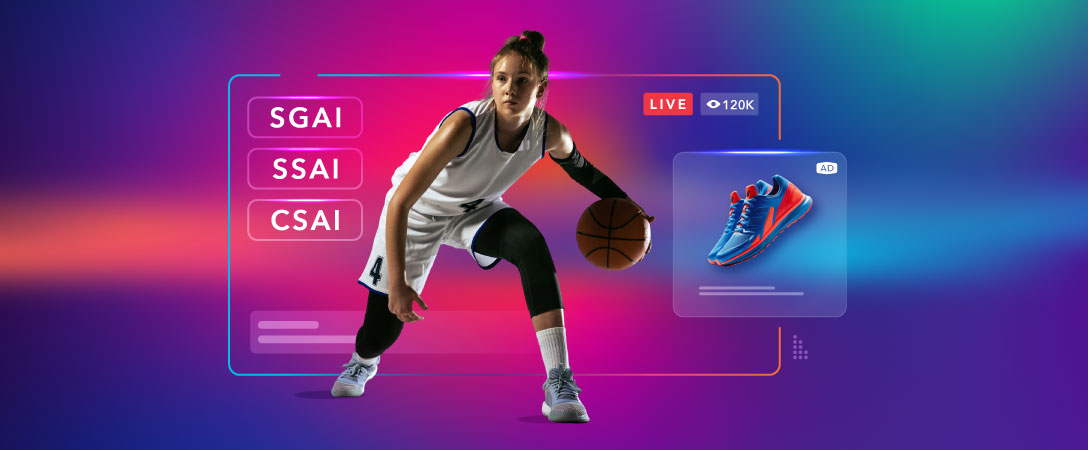
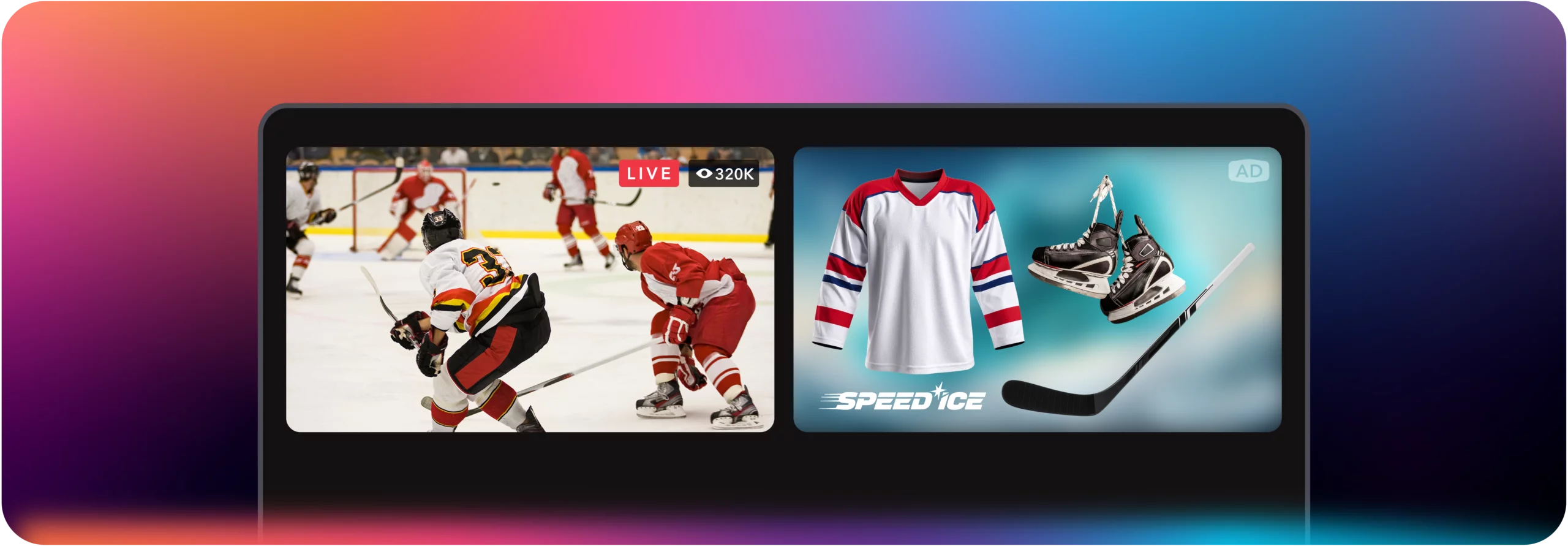
Server-side ad insertion solved the basic plumbing problem of getting ads into streams. Server-Guided Ad Insertion (SGAI) is pushing this further, giving the player itself the intelligence to manage ad decisions in real time, synchronizing ad pods with the live stream, adapting to device context, and reducing the latency spikes that make transitions feel broken. The industry is seeing CPM increases of around 25% for new, less intrusive formats like split-screen inventory integrated within live streaming. These are signs that the conversation is moving in the right direction. But we need to go further. Ad experiences that are designed around the specific rhythm of each sport, that understand when a viewer is locked in and when there’s a natural breath in the action, that add something to the experience, that feel like part of the broadcast. That’s the standard we should be aiming for. Otherwise, let’s stop complaining that people aren’t watching live anymore. If the ad experience drives them away, we did that to ourselves.
6. Each platform needs its own experience design
A phone on a commute, a TV in a living room, a tablet on a sofa, a set-top box in a sports bar. These are fundamentally different viewing contexts, and they each call for different features. The phone viewer wants quick stats overlays and vertical-friendly highlights. The TV viewer wants immersive audio, multi-view camera angles, and a lean-back experience. The sports betting user on a laptop needs real-time data panels and the lowest possible latency. Trying to deliver the exact same feature set everywhere is a mistake.
The real work is in understanding what each platform does best and designing the experience around that. A smart platform gives the mobile viewer a compact, touch-first interface with the features that matter on the go, and gives the living room viewer an expansive, cinematic presentation with spatial audio and richer overlays. The underlying stream quality needs to be consistently high across all devices, yes. But the feature layer on top of that stream should be tailored to how and where people are watching. Getting this right across web, mobile, smart TVs, set-top boxes, and gaming consoles, including in regions like APAC and LATAM where infrastructure varies wildly, is a serious video engineering and product design effort. The platforms that treat each device as its own product surface are the ones building lasting viewer loyalty.
7. Quality of Experience monitoring has become essential
QoE used to be something you checked after a major incident. Now it needs to run in real time, session by session. Startup time, rebuffering ratio, resolution stability, playback failures: these are the metrics that correlate directly with viewer abandonment. A rebuffer during a penalty kick is categorically different from a rebuffer during a pre-match analysis segment. Context-aware QoE monitoring that understands these differences is what separates reactive operations from proactive experience management. The Streaming Video Alliance and CTA have both formalized key QoE metrics, and the industry is coalescing around a shared understanding: what matters is whether content was actually watchable in the moment it mattered most.
8. Interactive features need real-time infrastructure from the ground up
Multi-view camera angles, live stats overlays, in-play betting integration, social interaction layers, gamification elements. The list of interactive features fans want keeps growing. Every one of them depends on a latency envelope that most traditional streaming architectures cannot guarantee. If your interactive poll result arrives three seconds after the play it references, the feature is worse than useless. Interactive live streaming is an infrastructure problem first and a product design problem second.
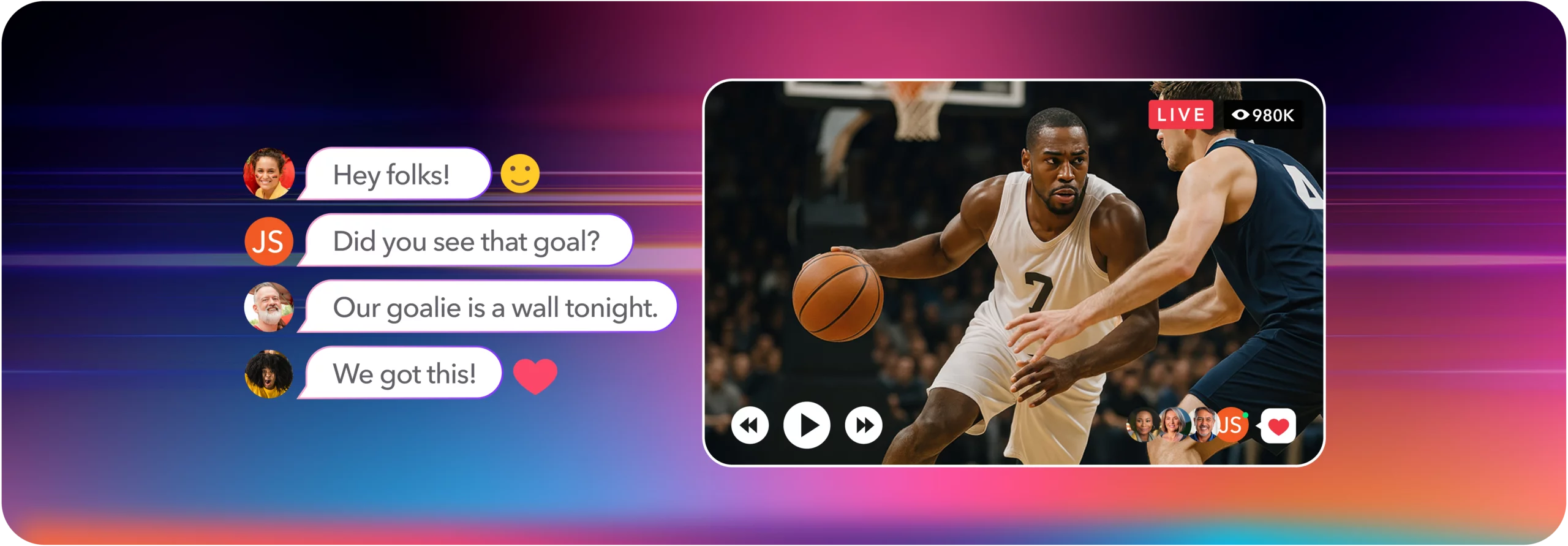
But here’s the thing that often gets lost in the conversation: you can build the most sophisticated interactive layer in the world, and it means nothing if people don’t use it. Adoption is the real challenge. And the way you drive adoption is by starting simple. Ridiculously simple. A live poll during a match. A quick prediction before a corner kick. A reaction button after a goal. Something that takes one tap, requires zero learning curve, and gives the viewer a small dopamine hit in return. You make that a habit first. Then you layer complexity on top of it over time.
My son Miles is 11, plays youth football here in Turin, and watches every Serie A match he can get his hands on. A few weeks ago he came to me buzzing because the streaming platform had added some basic interactive features during a game he was watching on his tablet. Nothing revolutionary. Simple stuff. But for him it changed the entire experience. He wasn’t watching passively anymore, he was participating. That’s the moment you’re looking for. If an 11-year-old picks it up instantly and comes back for it the next match day, you’ve found the right entry point. The sophisticated features, the multi-view angles, the deep stats panels, those can come later. The first job is to make interactivity feel like a natural part of watching, and that starts with something small enough that it becomes a habit before anyone notices.
9. The video stack is becoming a revenue engine
This is perhaps the most underappreciated shift. For years, the video technology layer was a cost line. You budgeted for it, you maintained it, and you hoped it didn’t break during a big match. That mindset is outdated. The video stack has evolved into a monetization platform, and the revenue opportunities it unlocks are compounding.
Start with advertising. Precision-targeted, non-disruptive ad formats increase fill rates and rendering rates. When ads are designed around the viewing experience (see point 5), eCPMs go up because engagement goes up. Split-screen inventory during live action, contextual overlays during replays, sponsored data panels during stoppages. Each of these is new ad inventory that didn’t exist in the linear world. And because the player knows exactly who is watching, on what device, in what context, and for how long, the targeting precision is orders of magnitude better than anything broadcast could offer.
Then there’s the content that the platform itself generates. Personalized highlights, real-time clips, post-match compilations. All of this can be automated from the live stream and distributed across social channels within minutes. That’s a second revenue stream, built on top of the same infrastructure, with minimal incremental cost. Multi-view camera angles and premium audio options can be packaged as higher subscription tiers. Interactive features like predictions and fantasy integrations open up sponsorship categories that traditional broadcasting never had access to.
The data layer underneath all of this is where the real compounding happens. Every session, every interaction, every viewing pattern feeds back into audience intelligence. That data improves ad targeting, informs content programming decisions, strengthens rights negotiation positions, and helps platforms understand exactly where the churn risk lives. A subscriber who consistently has a high-quality, engaging experience is a subscriber who renews. A subscriber who experiences buffering during key moments, or who never discovers the interactive features, is a subscriber on the way out. The video stack is where that loyalty is won or lost.
Sports content on the top five SVOD platforms grew 52% year-over-year in Q1 2026, and digital live sports audiences are projected to grow 5.8% this year. All of that growth needs to be monetized effectively, and the monetization increasingly happens at the player and delivery layer. The platforms that understand this are treating their video technology investment as a long term revenue driver with a measurable return, and they are pulling ahead.
10. Streaming is reaching broadcast-grade quality for live
Streaming carried the reputation of the lesser sibling for a long time: lower fidelity, longer delays, perceived as a secondary option for live. That reputation is outdated. Cloud-based production, real-time encoding, adaptive bitrate delivery, and ultra-low-latency protocols have closed the gap to the point where the conversation has moved to whether streaming can exceed broadcast quality.
With personalization, interactivity, and targeted monetization capabilities that linear never had, the answer is increasingly yes. We are finally at a point where we can create live sports video experiences that are genuinely amazing to use on any screen available. Phone, tablet, TV, laptop, set-top box. It all works, and it all works well. That’s a sentence that would have been aspirational five years ago. Today it’s real. The companies investing in a solid streaming technology foundation today, and creating their own interactive viewer experiences on top, are the ones that will define what “watching live” means for the next decade.
Final thoughts
The content wars get all the headlines. The experience war is where the real value is being created. The platforms that choose the right technology foundations and build their own viewer experiences on top of them are creating the kind of advantage that is very hard to see from the outside and even harder to catch up with once you notice it.
Sources
- A Guy With A Scarf, “YouTube TV’s Custom Multiview, and the Pro-YouTube Echo Chamber Around It” — https://aguywithascarf.substack.com/p/youtube-tvs-custom-multiview-and
- Sports Video Group, “Peacock Bringing Dolby Vision and Dolby Atmos to Live Sports Content” — https://www.sportsvideo.org/2026/01/05/peacock-bringing-dolby-vision-and-dolby-atmos-to-live-sports-content/
- NBCUniversal, “Peacock to Be First Streamer to Integrate Dolby’s Full Suite of Premium Picture and Sound Innovations” — https://www.nbcuniversal.com/article/nbcuniversals-peacock-be-first-streamer-integrate-dolbys-full-suite-premium-picture-and-sound
- Dolby Newsroom, “Dolby Sets the New Standard for Premium Entertainment at CES 2026” — https://news.dolby.com/en-WW/259256-dolby-sets-the-new-standard-for-premium-entertainment-at-ces-2026/
- FlatpanelsHD, “Peacock first streamer to commit to Dolby Vision 2” — https://www.flatpanelshd.com/news.php?subaction=showfull&id=1767689371
- NewscastStudio, “CES 2026: Peacock expands Dolby Vision and Atmos to live sports coverage” — https://www.newscaststudio.com/2026/01/08/ces-2026-peacock-expands-dolby-vision-and-atmos-to-live-sports-coverage/
- nanocosmos, “Video Latency and The State of Real-Time Streaming in 2026” — https://www.nanocosmos.net/blog/video-latency-real-time-streaming/
- nanocosmos, “Real-Time Streaming Trends in 2026” — https://www.nanocosmos.net/blog/real-time-streaming-trends/
- Red5, “Reflecting on 2025 and Sharing Live Streaming Trends for 2026” — https://www.red5.net/blog/reflecting-on-2025-sharing-2026-live-streaming-trends/
- Amazon Ads, “Live sports advertising trends in 2026” — https://advertising.amazon.com/library/expert-advice/live-sports-advertising-trends-2026
- Broadpeak, “Video streaming trends 2026” — https://broadpeak.tv/blog/video-streaming-trends-2026/
- Streaming Media Global, “The Six Big Advertising Trends that Will Shape Live Sport Streaming in 2026” — https://www.streamingmediaglobal.com/Articles/Post/Blog/The-Six-Big-Advertising-Trends-that-Will-Shape-Live-Sport-Streaming-in-2026-172174.aspx
- MNTN Research, “Sports Content on Top Streamers Climbs 52% in Q1 2026” — https://research.mountain.com/trends/sports-content-on-top-streamers-climbs-52-in-q1-2026/
- EPAM, “This Time, It’s Personalized: 2026 Trends in Content, Live Events & Sports” — https://www.epam.com/insights/blogs/this-time-its-personalized-2026-trends-in-content-live-events-and-sports
- Grabyo, “How low latency is closing the live delay gap” — https://about.grabyo.com/low-latency-streaming/
- Dolby OptiView, “What is Low Latency Video Streaming: The Complete Guide” — https://optiview.dolby.com/resources/blog/streaming/what-is-low-latency-video-streaming-the-complete-guide/
- TV Technology, “Personalized Advertising is Reshaping the Video Streaming Landscape” — https://www.tvtechnology.com/opinion/personalized-advertising-is-reshaping-the-video-streaming-landscape