
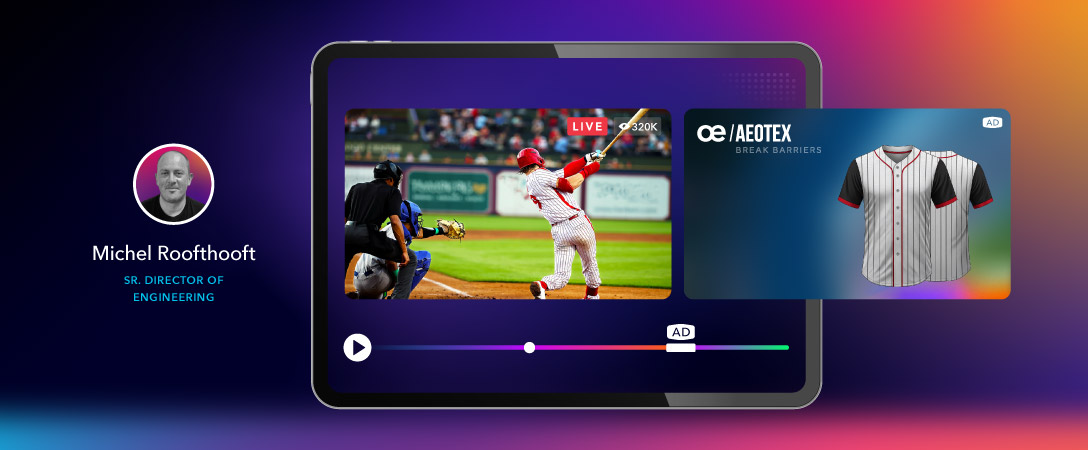
Recently, I interviewed Michel Roofthooft, Sr Director of Engineering at Dolby, to discuss the origins of Dolby OptiView, a suite of streaming components that incorporates the full latency spectrum, from low, ultra low to real time, live delivery, personalized advertising, and interactive playback, primarily for media and sports platforms. At the start, Michel explained that Dolby OptiView has three components: the OptiView Player, OptiView Ads, and OptiView Streaming. Central to OptiView Ads is Server-Guided Ad Insertion (SGAI), which coordinates the player, advertising, and streaming layers into a single, integrated system.
The conversation ran close to an hour. What follows is a focused summary of the most important points. Where Michel’s phrasing carries technical or strategic weight, I use lightly edited quotes. Everything else is paraphrased to keep the discussion readable while preserving the substance of the discussion.
You can watch the interview on YouTube here.
The Origins of OptiView Ads
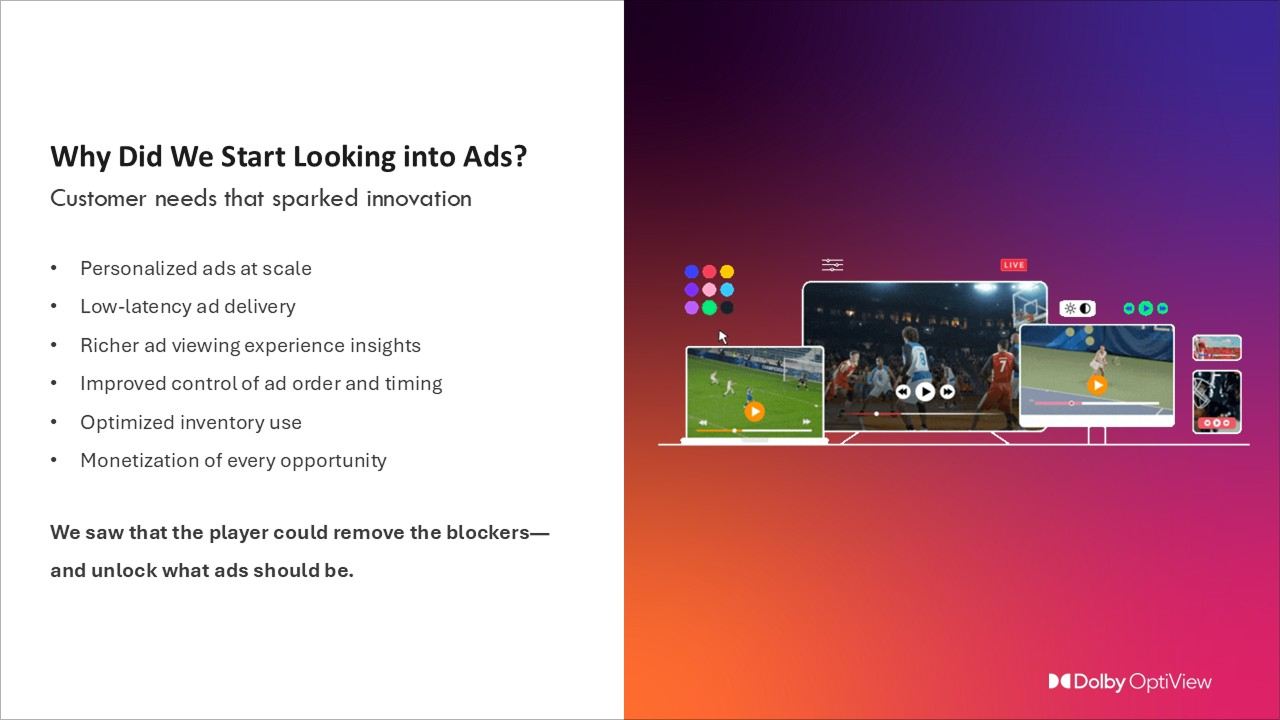
What prompted the interview as OptiView’s unusual origin story of the ads product. Specifically, OptiView Ads didn’t result from a conventional, internally driven product roadmap. As Michel explained, the process began when a major customer came to his team with a “shopping list of challenges.”
“They told us, ‘I need to personalize at scale. I want low latency. I want a richer experience. I want better control over which ads appear in each break.” The customer also wanted “less waste in the system and more flexibility overall,” setting a high bar for performance, personalization, and operational efficiency.
Faced with that list, Michel and his team didn’t treat it as a one-off request but as a blueprint for the next generation of streaming infrastructure. “We started thinking together with our partners,” Michel recalled. “What do we already have that could get us part of the way there? What gaps do we need to fill?” Combining those customer needs with their own insights, especially around low-latency playback and player behavior, Michel and his team began designing what ultimately became Dolby OptiView, a system tuned for the new realities of personalized, interactive live streaming.
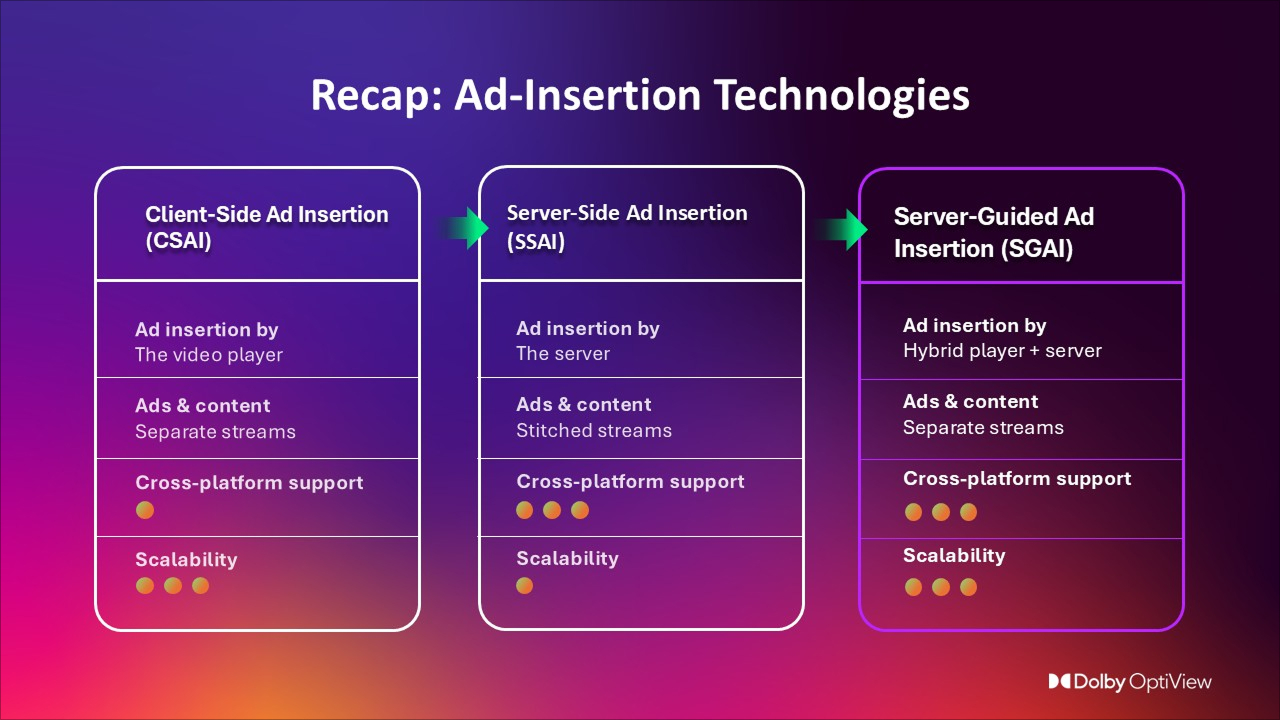
To explain the role SGAI played with OptiView, Michel compared CSAI, SSAI, and SGAI.
From CSAI to SSAI to SGAI
Michel framed CSAI, SSAI, and SGAI as an evolution the whole industry has lived through, not just Dolby. In his words, “people moved from client-side to server-side, and now more and more are engaging with this server-guided model of ad insertion.”
In the traditional client-side approach, “everything is done on the client… the client is in full control of the insertion, requesting the break, triggering the decisioning, and getting to an accurate splicing.” That model still shows up today, he noted, “mostly on VOD and for pre-rolls,” but it starts to creak when you try to scale across every device and app.
To solve that, many providers shifted to server-side ad insertion. “On live streaming today, people moved to the server side,” Michel explained. “You deliver to your video player a ready-made stream which already has the ads stitched in.” The upside is obvious: very broad platform coverage and far less logic on each client, which Michel likened to “the big cannon to shoot once and hit a lot of platforms.”
The tradeoff is just as clear. Because stitching and decisioning now happen on the server, “your server is doing that without really knowing who the player is or who the viewer is.” So, publishers lose device- and session-level data, limit personalization, and add complexity when trying to push that context back to the server at scale. At the extreme, “if you want maximum personalization, you end up stitching individual ad streams for every viewer,” which quickly becomes a scalability and cost problem.
Server-Guided Ad Insertion is Michel’s answer to those limits. “The idea of server-guided ad insertion is that you leverage the power of the clients,” he said. Coming from a player background, his team wanted “a hybrid between the two models” that keeps the server doing what it does best, which is conditioning the manifest, preparing the ad break, and making sure the player gets “a ready-to-use, fully optimized ad break,” while returning the actual decisioning and insertion to the player, “where it very naturally belongs.”
In practice, the server signals and prepares the break in a cache-friendly way, and the client initiates the decisioning call and performs the splice locally. That division of labor gives you the aggregate scalability of every client device and restores rich client-side insight and control. In addition, because the server can normalize formats and bitrates in advance, it makes it easier to support a wide range of platforms without asking each player to perform heavy parsing or complex format juggling.
Avoiding the Pain Points of CSAI and SSAI
After Michel walked through this evolution, I pushed on some of the practical tradeoffs. First, I asked how SGAI sidesteps the two classic complaints about client-side ad insertion: ad blockers and jarring transitions between content and ads.
On ad blocking, Michel was blunt: both client-side and server-side can have their impression beacons blocked, because “the bits that signal back to the advertiser are still easily blockable.” What changes with SGAI is that the client regains a say in how to respond. The player can detect the presence of an ad blocker and feed that signal into business rules: “Do you want to prevent the session? Do you want to show a promo asking to disable the blocker? Do you want to swap in promos instead of paid ads?” That flexibility, combined with techniques like delivering ads from the same domain as the content, can make life much harder for generic blockers without breaking the experience.
The second CSAI pain point was playback quality. In pure client-side workflows, mismatched codecs, container formats, or frame rates often translate into spinners and multi-second gaps when switching between content and ads. Michel noted that they had just seen “3–5 second spinners” in a customer’s lab setup using client-side insertion.
With server-guided, the server preconditions the ad break, matching codec, timescale, and frame rate to the program stream, so “you can use the same video decoder and get a very seamless experience, even on older, more challenging big-screen devices.” At the same time, the player becomes more lightweight: it no longer must parse complex VAST responses or juggle multiple decoders, but instead operates on an ad break that is already prepared for smooth stitching on that specific device class.
SSAI: Cost Scales with Personalization
I also asked how SGAI compares to SSAI in terms of cost and scale. Michel explained that fully personalized SSAI means “every viewer that tunes into your stream needs their own experience, their own ads,” and if you add advanced formats like L-shapes or double boxes, “you need to do all of that on the server side on an individual basis.” This per-user transcoding and stitching burden is what drives up infrastructure cost and complexity.
SGAI, by contrast, removes those stitching chores from the server. The server still conditions the ads and signals the break, but this happens once per ad, and the actual insertion happens on millions of clients in parallel. You keep the broad device reach that made SSAI attractive in the first place, while avoiding the need to render a unique stitched stream for every viewer and every break.
With SSAI, cost and infrastructure requirements scale directly with personalization. With SGAI, additional personalization adds little to overall system cost.
How SGAI Works: Architecture and the Google Partnership
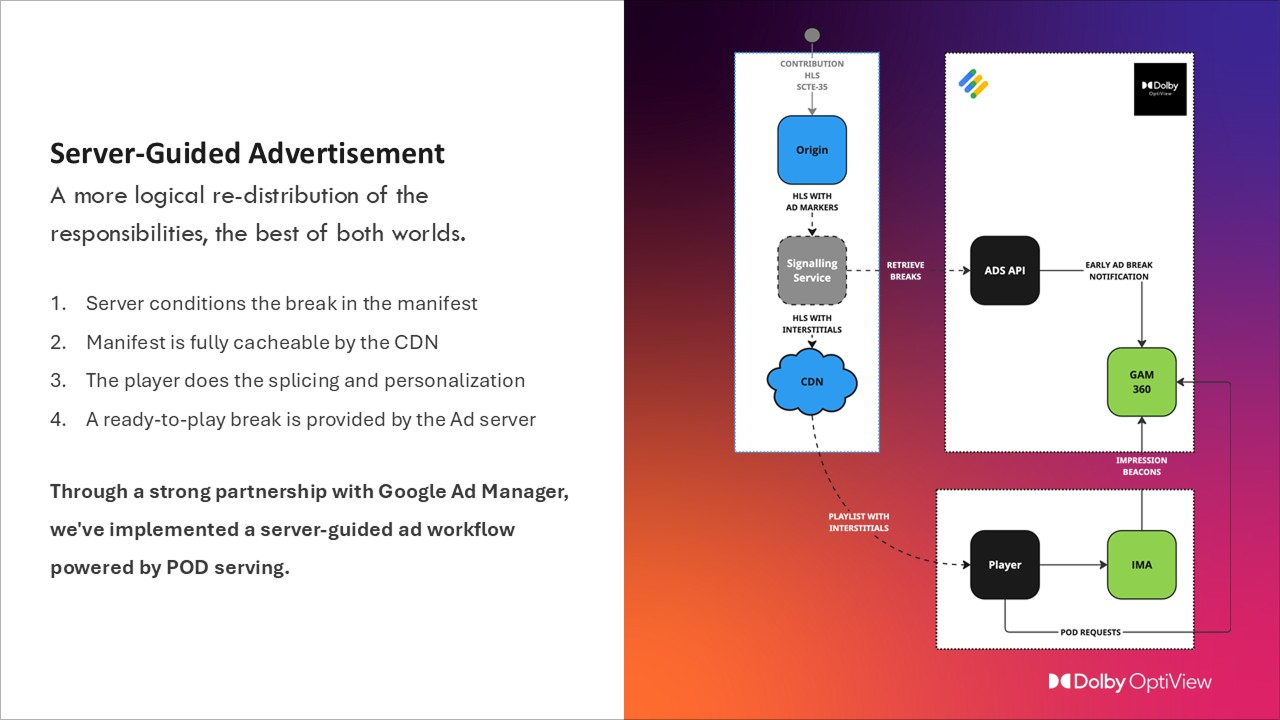
The next slide showed the SGAI architecture, which Michel described as more logical than SGAI or CSAI in terms of “how the responsibilities have been distributed. “Crucially, Michel emphasized that SGAI uses “a manifest that’s completely anonymous.”
In practice, which means it is not personalized or tied to a specific user; it contains generic break signaling that applies to any viewer at that point in the stream. Because the manifest is non-unique, the CDN can cache and reuse it for the entire audience, rather than the server generating a different manifest for every session.
As Michel stressed, “this gives you a lot of scalability out of the box.” That’s a key difference from many SSAI workflows, where the manifest is personalized per viewer and effectively unique, which prevents broad CDN reuse and pushes more work back to the origin.
In addition, the server is not returning vague ad slots or generic responses; instead, it returns “a fully playable ad break” and “ready-to-stitch content.” The player then handles “the splicing and the personalization,” which is the key shift from SSAI. That redistribution lets the server focus on preparing optimal, cacheable break signals while the client does the actual work of selecting which ads to insert and threading them into the stream.
As Michel described, the architecture took shape through intensive work with Google. “We started with a very strong partnership with Google and are very much pre-integrated with our solution today.” More importantly, the team and Google have “developed hybrid workflows where we can get to the best of both worlds through server-guided, but also server-side if it would be really necessary.” That flexibility matters because not every customer uses Google Ad Manager.
Lately, the team has been “developing with pilot customers the ability to integrate with any VAST-compliant ad server,” while making sure “the right conditioning of the break is happening before it gets to the player.” This preserves the same architectural benefits even outside the Google ecosystem.
Personalization and Dynamic Ad Insertion at Scale
Next, I asked what customers were really looking for in terms of personalization. Michel’s answer started with the quality of experience, not targeting. “First, customers want a very good experience in their content,” he said, “but now they also want the same quality of experience in their ads.” That means answering basic questions like: Is the ad playing without buffering? Is it at the right quality? Is the transition seamless?
Beyond that, Dolby customers are pushing for “a higher degree of personalization,” where “the ads that are being served to you as a client are relevant to you.” This drives higher CPMs, satisfies advertisers, and makes viewers more likely to stay with the stream.
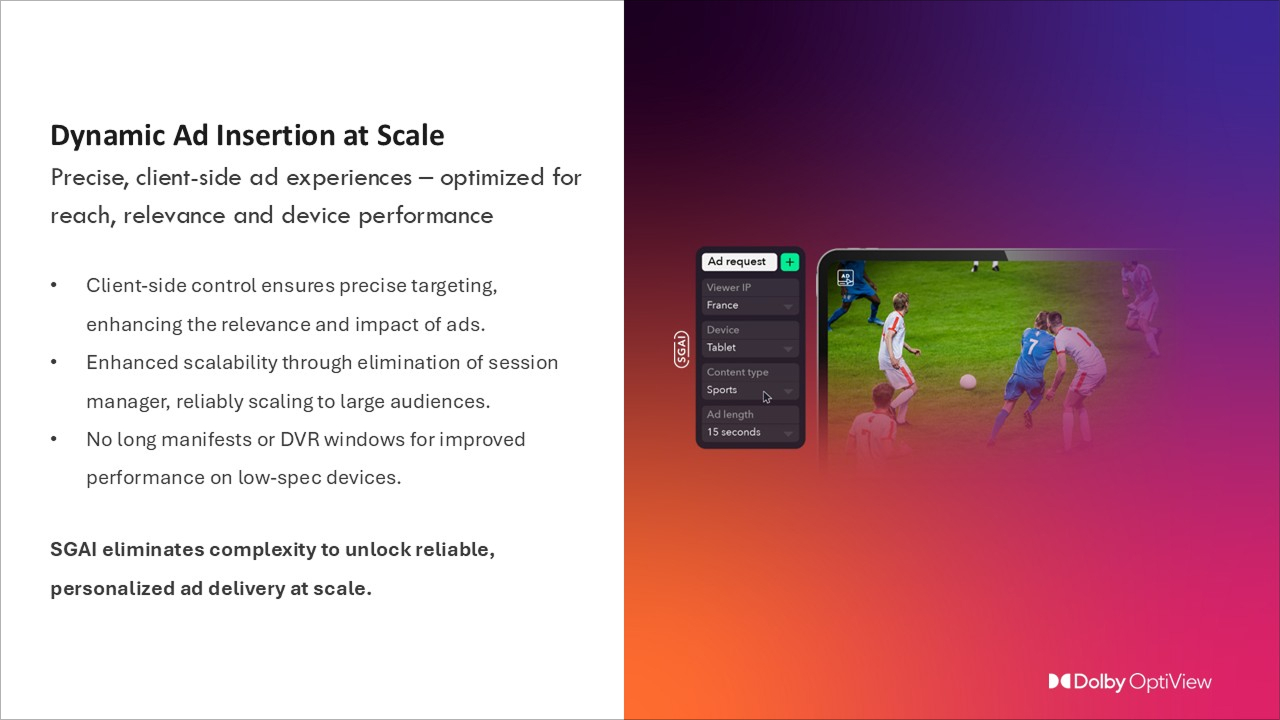
As Michel described, SGAI gives customers capabilities they didn’t have before. Once SGAI is in place, they “start exploring the possibilities” of much more granular targeting: very localized creatives for a local sponsor of a local sports stream, or new web-style formats that let you keep the main program visible while “throwing in an ad or even another piece of content” so the experience stays engaging.
In practice, he pointed out, most customers are still early on that journey. Today, many live streams rotate through “a very limited pool, 40, 50 ads, maybe even for the bigger brands” because their existing systems can’t support much more. As SGAI rolls out, sales teams begin to see “the number of permutations of those ads start to grow” and start selling against those options, while mixing different creatives, placements, and formats like an L-shape or a straightforward replacement.
When pressed for a percentage of ads that are personalized today versus where they might be in 6–12 months, Michel resisted putting a number on it. The critical point, he argued, is that by bringing insertion back to the client, “you get more insights on the experience.”
The player can now report quality-of-experience metrics for ads, not just for content, including whether viewers are seeing buffering, how smooth the transitions are, and how those ads perform on specific devices. That feedback loop, combined with finer-grained control over which ad each viewer sees, enables personalization to grow over time without sacrificing reliability or user experience.
Unlocking Richer Ad Insights
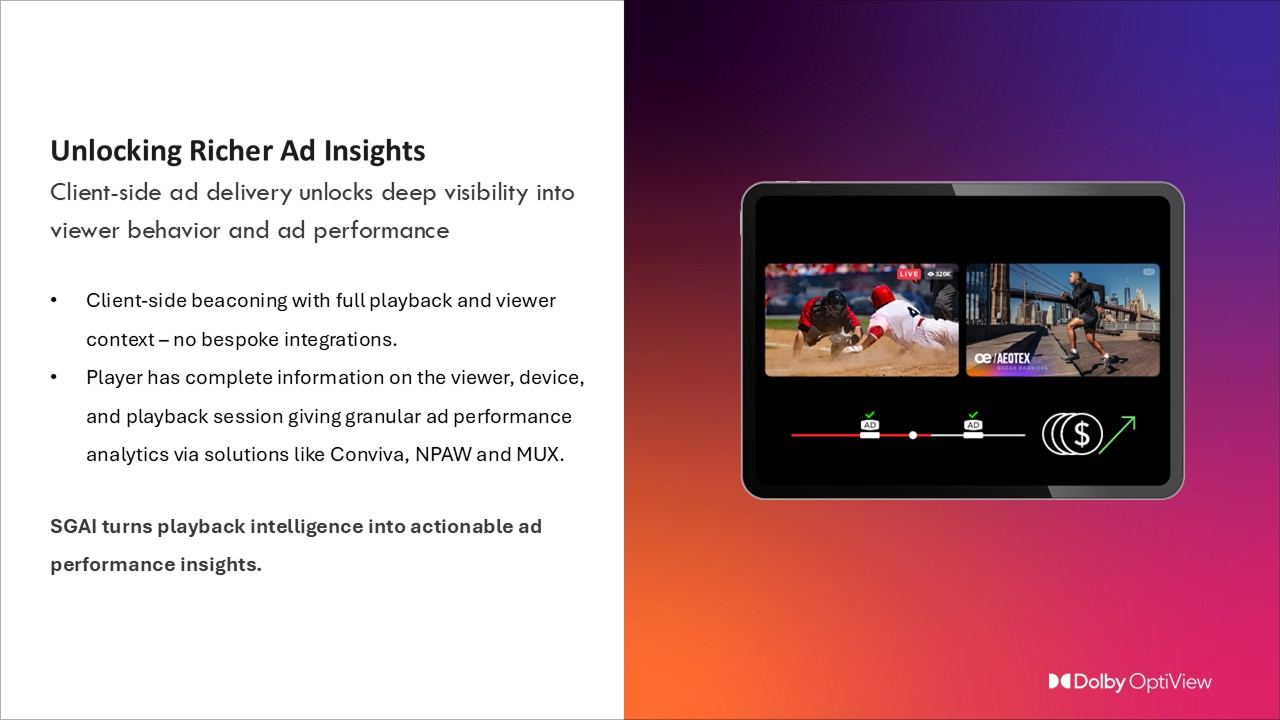
As we dug deeper into client-side insertion, Michel emphasized that personalization and measurement are tightly linked. With SGAI, the player not only controls which ad a viewer sees, it also “gets you more insight as an advertiser: is the ad actually watched by the viewer?”
Client-side beaconing can capture whether the ad played at the right quality, whether there was buffering, and whether the viewer stayed engaged instead of tabbing away or pushing the video to the background. That viewability signal makes advertisers “more willing to pay more for the ad space you’re offering,” because they have stronger assurance that impressions are real.
Those same beacons also matter to the publisher. On the content side, the player can measure whether the transition into and out of an ad break stutters, or whether the ad runs at noticeably lower quality than the main program. “A lower quality of the ad is typically also perceived as a lower value of the brand that is being advertised,” Michel noted, so being able to detect and fix those issues benefits both the programmer and the advertiser.
You could, in theory, push some of this metadata from client to server in an SSAI workflow, but Michel called that “very bespoke development” that must be managed per client. In the SGAI model, “the data is there” on the client, so “that should also be the source that is reporting it and will also be the source that is being trusted by the advertisers.”
This is where integrations with QoE vendors come in. When I asked whether data sharing with tools like Conviva, NPAW, and Mux required extra work, Michel was clear: “That is something that is baked in today.” Over the years, those partnerships have matured to the point where all of them can track ad-related playback data, so SGAI can “turn playback intelligence into actionable ad performance insights” without bespoke instrumentation on every project.
Low Latency + SGAI: Making the Timing Work
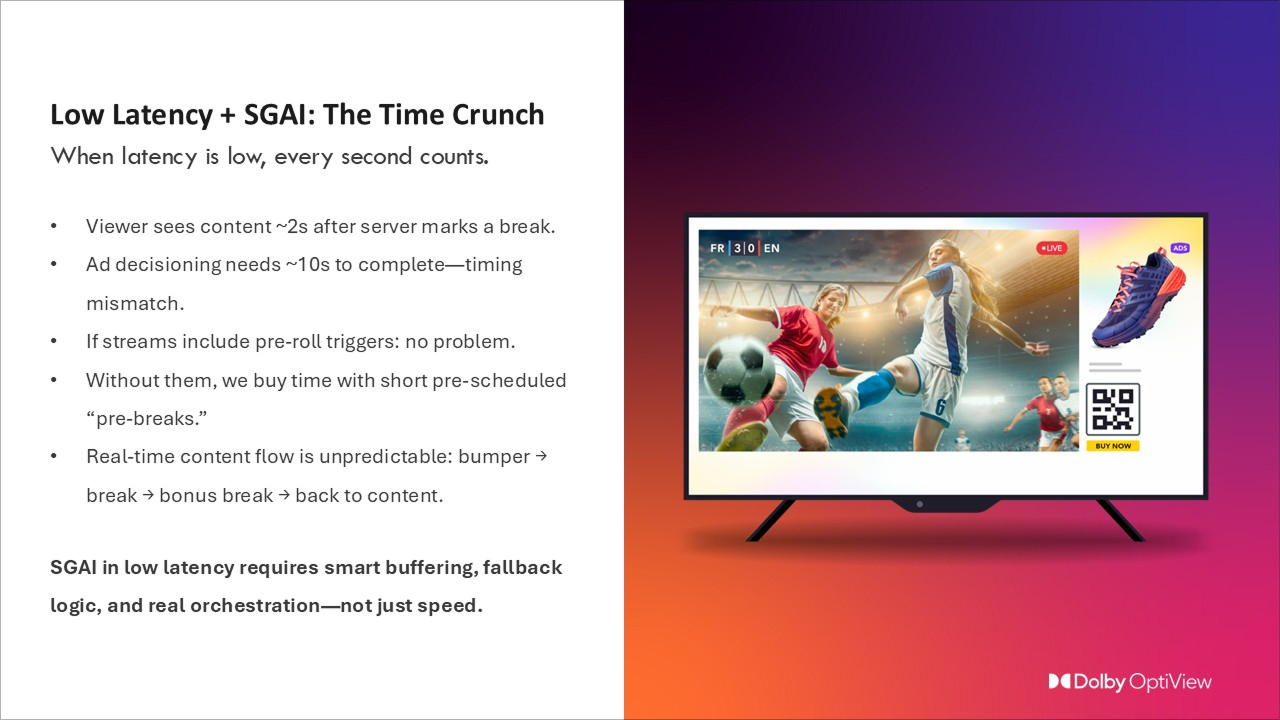
Low latency was one of the main reasons Michel’s team concluded that server-guided ad insertion was “the way to go.” On the server side, he explained, “the moment you need to serve your manifest, you need to serve out your stream, you need to have your ads ready. You need to have your decisioning done.” All that work, like assembling the manifest, waiting for ad decisions, and preparing the stream, adds latency and join delay, which is exactly what low-latency workflows are trying to avoid.
With SGAI, the server’s role shifts to accurately signaling the break to the client. That lets the player “pre-load the ad, trigger the decisioning ahead of time, make sure it has the ad content ready to go, and at the right moment, at the right frame, even at low latency, switch over to the ad break” with a seamless experience.
When I asked him to define the latency, Michel’s answer was architecture-agnostic. “We can do this with any architecture,” he said, including DASH, low-latency HLS, traditional HLS, and even WebRTC. In practice, many customers are targeting “a broadcast latency of 8 to 10 seconds, easily, with all the personalization you need,” because that gives them synchronized playback, high quality, and stability.
The same approach can be pushed lower: “we’re also doing this at lower latencies, in the 2 to 5 second range,” as long as you account for the tradeoff that “the more time you give to the decisioning of your ad break, the better ads you’re going to get back.” As latency drops, orchestration becomes crucial; triggers and pre-break signaling must fire early enough for the ad server to still have time to return a rich decision.
From the customer side, the sweet spot today is a broadcast-like experience: everyone roughly aligned in the 8–10 second range, with reliable personalization and the option to tune latency down later without giving up features. Michel summed up their ask as “a more efficient ad-insertion technology” that doesn’t force a choice between low latency, monetization, and experience.
Smarter, Less Wasteful Ad Breaks
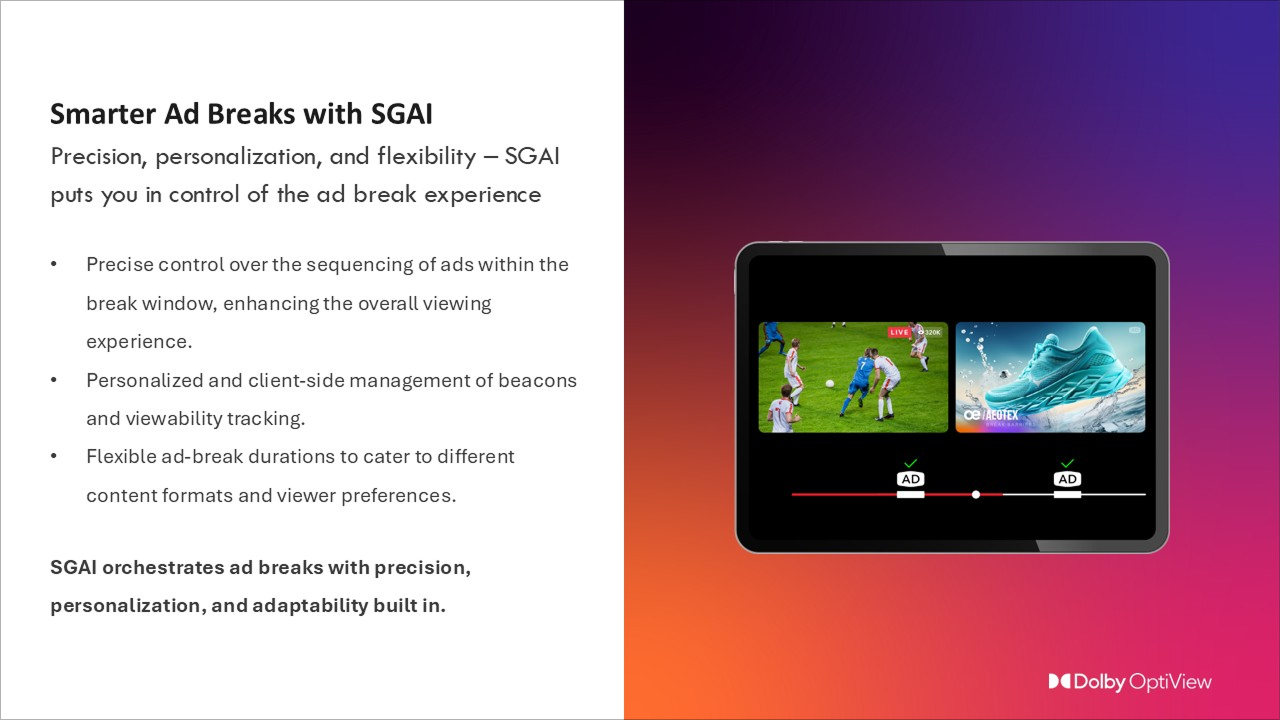
When we shifted from latency to ad-break control, Michel framed customer demands in terms of efficiency. “Customers were asking for a more efficient ad-insertion technology,” he said, and that broke down into two concrete asks. First, they wanted the ability to “more accurately schedule a break at the last minute” so they can decide when to insert ads based on what is happening in the game or the program. If something significant happens on the field or in the stream, they want to react quickly, either to highlight that moment with a relevant creative or to cover something unexpected, instead of being locked into rigid, pre-scheduled pods.
The second ask was to cut waste out of the workflow. In many existing systems, the platform starts calling for ads well before it knows whether a viewer will see them. This means reserving “precious ad inventory for users that maybe never scroll back in your DVR window, or maybe already moved away from your stream.”
With SGAI, Michel’s team focused on requesting ads only when there is a high likelihood they will be played, so impressions are tied to real viewing rather than hypothetical future playback. The result is “more flexibility, but also less waste in the technology, in the workflow,” giving publishers tighter control over when breaks happen and advertisers’ better utilization of the inventory they are paying for.
Putting Numbers to the Promise: SGAI vs. SSAI Results
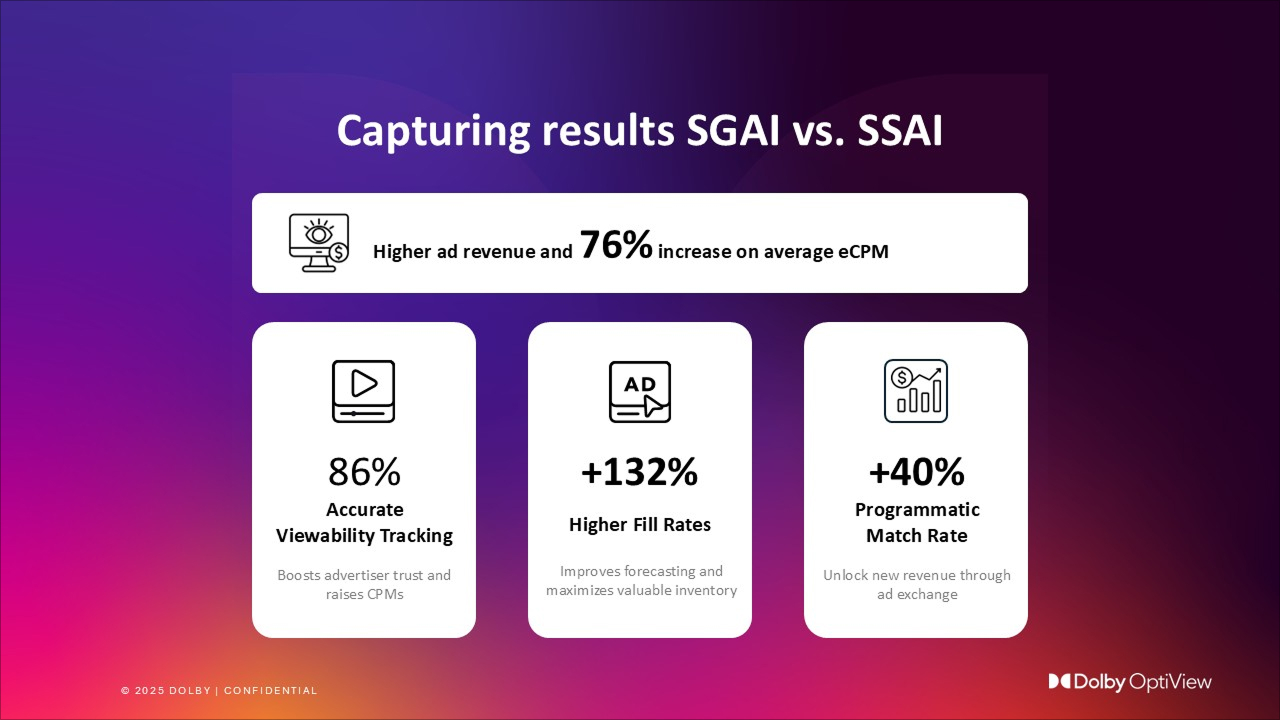
Next, we turned to real-world impact, and Michel cited results from a tier-one sports customer that agreed to a clean A/B test. “Same application, the same content, same viewers,” he said, “and a true A/B test between, on one hand, the existing SSAI stack and, on the other hand, SGAI replacing that stack.”
“Just by replacing the ad-insertion technology and nothing else,” Michel recounted, the customer saw “these exciting numbers.” Specifically, that meant a 76% increase in average eCPM compared to their SSAI baseline, with no changes to the app, the programming, or the audience.
Michel attributed that lift to three pillars. “First of all, better viewability tracking,” where the client can “tell the advertiser, yes, the viewer is watching and is engaged with the content.” In this deployment, that translated into 86% more accurate viewability measurement, which makes buyers more comfortable bidding up.
Second, “better fill rates,” because “the ads that are actually being auctioned are also actually being inserted and being used in the stream,” not just reserved and wasted. As shown in the figure, the measured fill improved by 132%. Third, SGAI “unlocked programmatic revenue” by offloading “more precise data from the client and from the viewer” into open auctions, driving a 40% improvement in programmatic match rate and higher CPMs on that inventory.
“The nice thing,” Michel added, “is these are results that we got throughout the rollout,” with the system live for more than a year. In a recent re-run of the analysis, some metrics were “upwards [of] 390% compared to the old system,” as the customer’s teams learned to sell and operate against the new capabilities.
As Michel put it, using all those clients “gives you actually massive scale,” so “you don’t need to track every individual viewer, every individual session” on a centralized stitching farm. Personalization happens on the player, not in a fragile central component that people are afraid to touch in a tier-one sports workflow.
Higher Revenue Lower Cost
As Michel next explained, the increased revenue is only half the picture; the cost side is equally important. Michel addressed it directly: “You don’t need to personalize every individual session on a central server. You’re doing that on the client side, so you don’t need any infrastructure for that.” But beyond raw stitching costs, SSAI carries a hidden operational burden.
In large deployments, particularly tier-one sports, the central ad-insertion component becomes a complex, fragile piece of infrastructure that “typically people don’t try or don’t dare to touch” because the risk is so high. By shifting insertion and personalization to the player, the customer reduces the amount of heavy infrastructure they need to operate and frees teams to evolve the system without constantly worrying about breaking a monolithic server-side ad stack.
Innovative Ad Formats, Personalized
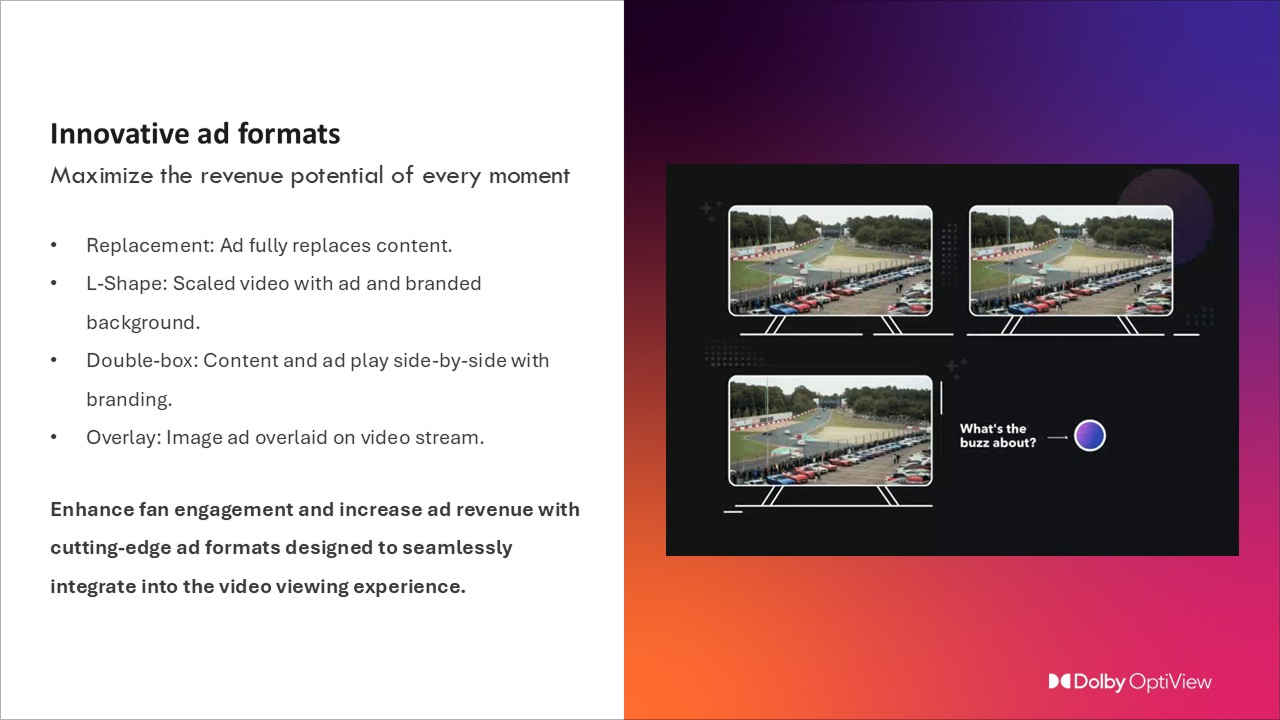
When we turned to ad formats, Michel started with the obvious: “We all know the ad that takes over the full screen, and of course, that’s still possible.” What excited him about SGAI was everything it unlocks beyond that.
For example, with SGAI, the same underlying architecture can drive L-shape layouts “with an ad in the video feed” while the content continues. It can also deliver double-box views “where you keep your viewers still engaged with that content… but you also show an ad next to it.”
For advertisers, those units are “very precious” because they can be tied to “a certain element in the game or in the action that is happening,” rather than just being dropped into a generic break. Over time, he said, customers have also adopted “simple personalized image overlay” formats that bring ads into the video feed in a very non-intrusive way.”
I asked whether these experiences were truly unique to SGAI or whether they could also be delivered with SSAI or CSAI. Michel’s answer was nuanced. The formats themselves, like double boxes and L-shapes, “we’ve all been seeing… in production,” but historically, “they are the same for everybody.” What makes them different in a server-guided model is that “these are personalized to you as a viewer.”
In theory, he continued, you could also build this with client-side insertion, “because with CSAI you have control on the client.” But then you must implement and maintain that logic “on all of your different platforms.” And if you can’t deliver the ad in the right format, resolution, and codec at the right time, “a lot of the nice experience goes away.”
As Michel put it, “imagine that you do a double box, and the ad shows a spinner… probably you crashed the party already.” SGAI’s combination of server-side conditioning and client-side control is what makes those richer formats both personalized and reliable at scale.
Beyond Ads: Instant Replays and Personalized Experiences

One of the most interesting insights Michel shared was that when learning about SGAI, “customers immediately say, this is actually an experience that I can create, and that doesn’t have to be an ad. That can be a highlight, that can be a replay, that can be a clip of another game.”
To explain, the same underlying mechanics that stitch in a personalized ad can stitch in an instant replay or a highlight reel, and the player can surface it “on all of the platforms that you are serving.” In a live-sports context, Michel explained, editorial teams can detect “a change of players or some review,” and trigger content from the server side to “keep every viewer connected to the experience.”
If a viewer is a fan of a particular team, the platform could show that team’s highlight; if it detects a dull moment, it could replay an earlier action or tease another game. All personalized, all at the client level, without requiring individual stitching on the server.
Adoption is still early, mirroring what Michel described earlier with personalized ads: “You see people realizing this, gradually adopting.” Right now, customers are using these overlaid experiences to show promos that might “draw customers into subscription by showing a highlight of what they could watch,” and to keep engagement steady during downtime.
But Michel was emphatic: “The use cases are endless.” With co-creation and customer feedback driving the roadmap, the same technology is becoming a canvas for highlights, replays, teasers, and any kind of “experience” a broadcaster can imagine.
Standards, lock‑in, and the player
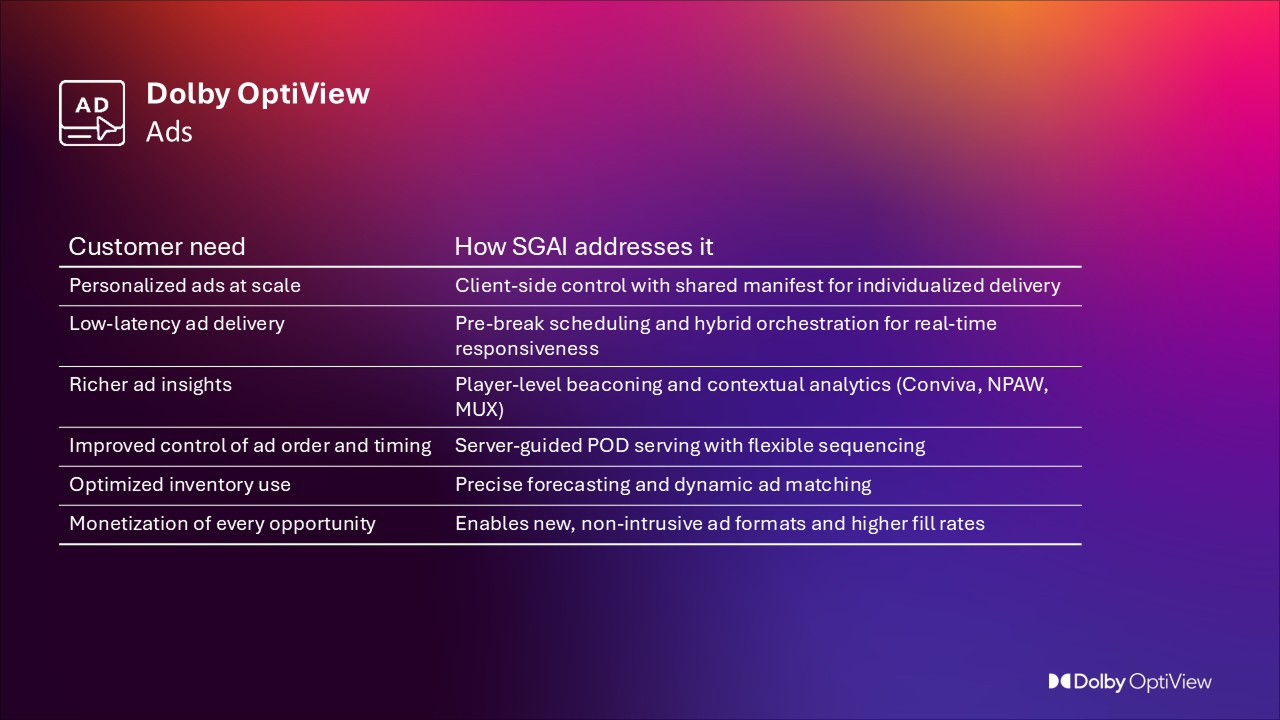
This is the point in the interview when Michel detailed the origin story which you’re already heard. Hence the slide content, which is the list the client passed along to Michel and his team.
As we wrapped up, Michel explained where SGAI sits in the broader ecosystem. Traditional CSAI and SSAI flows are well standardized, which helps minimize lock‑in. SGAI is newer, and while there is “a lot of buzz” and active work on standardization, Michel was clear that his team chose not to wait. They pushed into more real‑time signaling, like being able to end a break early, switch to a different break while one is playing, or layer richer formats. Then they aligned that with emerging specs rather than letting the specs define the ceiling.
On the vendor lock‑in question, he flipped the perspective: the real orchestrator is the player. You can standardize interfaces, but to get seamless experiences and advanced formats with correct signaling, codecs, and fallbacks, “a central component which handles a lot of complexity” must live in the player. His view is that SGAI is one coordinated system: a hardened, cross‑platform player, server‑side signaling and conditioning, and integrations with partners like Google Ad Manager and other VAST/FAST‑compliant ad servers, rather than a loose collection of interchangeable parts.
Roadmap: hybrid workflows and radical simplification
Looking ahead 6–12 months, Michel expects three main threads. First, hybrid workflows: preferring SGAI wherever possible, but automatically falling back to SSAI on platforms or use cases where SGAI isn’t yet a fit, choosing “the right technology at the right time.” Second, continued expansion of formats and ecosystem support, including more mature implementations of L‑shapes, double boxes, and overlays, and deeper integrations with additional FAST‑compliant ad servers so customers can bring their existing ad‑tech partners along.
Third, and most important in his view, is the radical simplification of onboarding. The goal is to make something very complex “super, super simple,” where a customer can hand over an origin URL, receive a player configuration, and start monetizing with “three or four clicks,” inserting breaks via a straightforward API.
In this schema, the heavy lifting, including low‑latency orchestration, personalization at scale, richer experiences, and efficient inventory use, stays within OptiView. This enables customers to focus their energy on creative formats, sales, and inventory, rather than rewiring their ad stack every time they want to try something new.
Summary
As you’ve heard, Michel traces Dolby OptiView from a customer’s “shopping list” of requirements to a production system that now checks those boxes: personalization at scale, low-latency delivery, richer insight, tighter control of breaks, and less waste. Over roughly a year in the field, SGAI has turned those capabilities into measurable uplift, with substantially higher eCPMs, better fill and match rates, and lower infrastructure burden.
For ad‑supported services, particularly live sports, where latency, reliability, and inventory value are all under pressure, that combination of revenue impact, operational efficiency, and experiential flexibility makes OptiView a serious contender for any next‑generation streaming roadmap.