
Why Server-Guided Ad Insertion Succeeds Where CSAI and SSAI Fall Short
The promise of Digital TV was personalization: the ability to deliver ads that match the viewer, the moment, and the local context. Personalization was the key to more effective advertising, delivering better ROI for advertisers and increased CPM for publishers.
But the industry never fully delivered on that promise. The problem has been the technologies used to deliver ads, Client Side Advertising Insertion (CSAI) and Server Side Ad Insertion (SSAI). Both solved problems, but neither made true personalization routine in production.
With SSAI, the client device is abstracted away from the ad decision, which limits the real-time exchange of information between publishers and advertisers. As AdExchanger explains, publishers must take additional steps to pass signals like client IP address and device information back to the ad server, typically by inserting X-Device-IP and X-Device-User-Agent headers into the request.
While this can restore some device-level data, the approach is optional, inconsistently implemented, and still restricts two-way communication at impression time, making real-time targeting, optimization, and dynamic creative difficult to achieve. In practice, the workaround recovers some signals, but not enough to support consistent, impression-level personalization.
Datazoom observes the same limitation from the measurement side, noting that SSAI “masks the user’s identity and device information,” which makes accurate attribution difficult and reinforces how the loss of viewer context affects both targeting and measurement.
Even the IAB acknowledges that standards alone don’t change this dynamic. VAST 4.2 and OMID improve verification and metadata support, but they don’t alter the underlying workflow in which the ad decision remains separated from the viewer context.
On the other hand, CSAI supports personalization because the ad request originates on the device. The challenge is reliability and reach on CTV. The IAB’s CTV Signal Loss report notes that identity and device-level signals are often incomplete or inconsistent across TV environments, which makes it difficult for buyers to deliver personalized experiences reliably. CTV delivery chains lose critical identifiers and metadata in ways that disrupt audience targeting and attribution.
Measurement companies have echoed the same issue. Nielsen reports that CTV platforms vary widely in device capabilities and data availability, which complicates consistent ad execution and undermines personalization at scale. CSAI has access to the signals personalization needs, but CTV device variability and uneven signal availability mean those personalized decisions do not always translate cleanly into a stable viewing experience.
The result is a strange contradiction. The industry talks constantly about personalization. Buyers demand it. Smaller publishers depend on it. But the dominant ad insertion workflows still make it difficult to act on viewer-level relevance at the exact moment it matters.
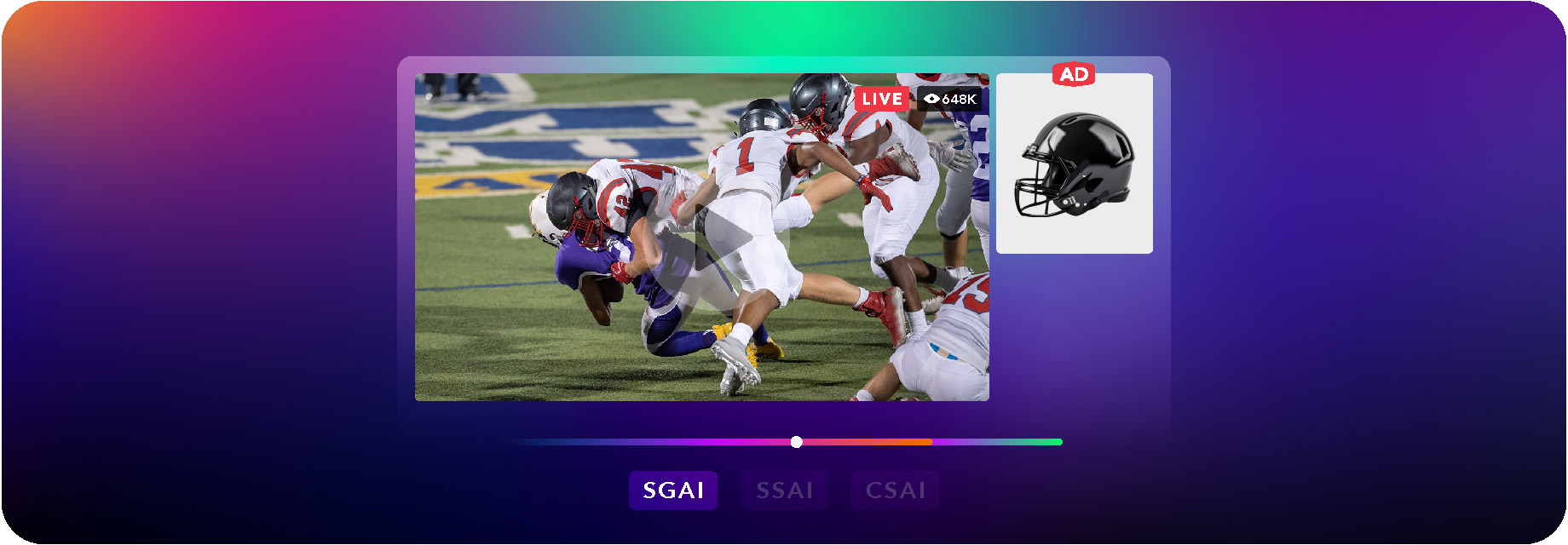
SGAI: Architected for Personalization
The core issue with personalization is architecture. You can’t fix upstream signal loss, server load growth, or device fragmentation with more metadata or clever workarounds. At some point, you have to change who does what.
Server Guided Ad Insertion, or SGAI, does that by splitting the workflow differently. The server defines the ad opportunity. The client makes the ad request and stitches the creative. The ad server preconditions that ad to match the primary content, so the player can play it seamlessly. These changes are enough to unlock personalization that CSAI cannot deliver consistently, and SSAI cannot provide at scale, while ensuring the best possible viewer QoE.
This workflow matters because the decision ultimately occurs where the viewer-level signals reside. That is the heart of every personalization scheme, regardless of the ad format. The difference is how much work the device has to perform to make that decision usable in practice.
With CSAI, the device carries the entire ad stack. It has to load and execute the ad SDK, interpret tags, evaluate tracking logic, manage errors and fallbacks, and coordinate event reporting. That is a heavy workload even for a modern streaming device, and it becomes unreliable on lower-powered smart TVs and dongles. CSAI gives you the right signals, but does not guarantee the device can deliver a stable personalized experience.
SGAI approaches the problem differently. The client still uses its own context to request an ad, but it does not assemble or interpret anything. The server has already identified the opportunity and the creative, and the client receives a preconditioned media segment that matches the content stream, making it easier to play and minimizing the risk of freezing or other playback discontinuities. This architecture is simpler for low-power devices, minimizing the workload so even inexpensive smart TVs and dongles handle it consistently.
Taken together, these characteristics explain why SGAI performs well in live and high-concurrency environments. The personalization decision is made at the device, where the signals live, but the device is not asked to run logic it cannot support. Meanwhile, the server is not burdened with generating unique streams for each viewer, so personalization finally scales without compromising quality or latency. For the record, ad blocking is not a major factor in most CTV and mobile environments, where the majority of ad-supported viewing occurs. SGAI does not eliminate ad blocking on computers, but because ad delivery does not rely on browser-executed ad calls and control logic, it is generally less exposed than CSAI while preserving viewer-level personalization.
Personalization in Practice
Let’s explore SGAI and personalization in action. Hudl is a Lincoln-based platform that high schools use to produce sporting events, and it streams more than 1 million games a year. The audience is unusually engaged, with long session times and heavy highlight sharing, which has attracted both national and local advertisers.
Personalization is central to Hudl’s model because its audience is not fixed to a single community. Even during local games, viewers include families, alumni, rivals, scouts, and out-of-town fans, and Hudl’s large highlight ecosystem reaches far beyond the school that produced the clip. Advertisers want that nuance. National brands vary campaigns across thousands of micro markets, and local sponsors only want to reach viewers who are actually relevant to their business. Hudl’s ability to personalize at the viewer level is what makes those buys possible at scale.
In a recent Streaming Media interview, Hudl’s VP of Media, Adam Gouttierre, describes targeting that goes far beyond broad demo groups. He explains that Hudl can tailor campaigns by “geography, school, sport, or gender,” which is precisely the level of specificity that legacy SSAI architectures struggle to deliver.
As examples, Gouttierre cites the Union Bank in Nebraska, which focused on connecting with high schools in and around Lincoln, NE. This allowed UBT to engage deeply with a passionate local audience, which is critical given that, according to the National Retail Foundation, 80% of fans are more likely to trust, purchase from, and recommend brands that support their local teams. In terms of national brands, Gouttierre mentioned that companies like T-Mobile seeking to reach a broad swath of viewers engaged in an intensely lean-in experience.
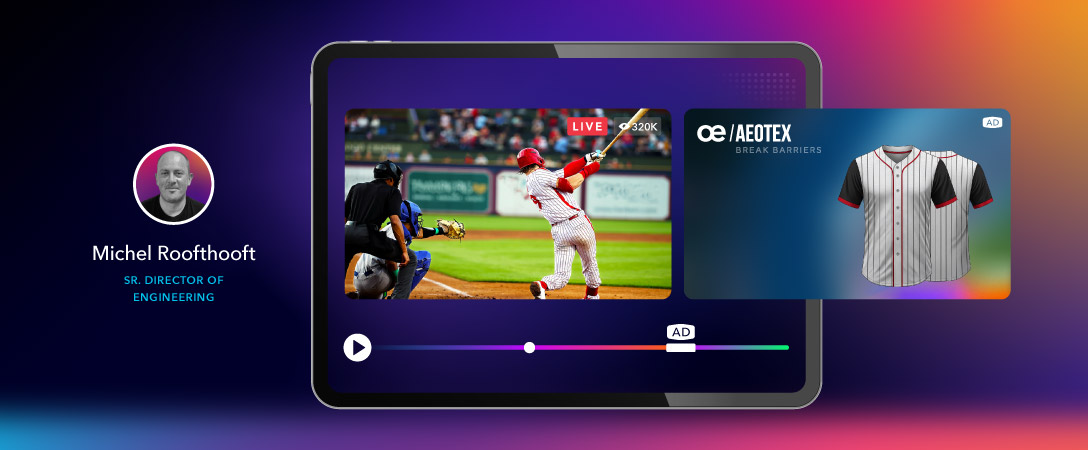
Hudl has deployed Dolby OptiView, which pairs personalization with formats that keep the game continuous. In the Streaming Media Interview, Gouttierre notes that streamers can use L Bar or side-by-side ad layouts to display ads while the game stays front and center. The formats themselves are not personalization, but they make personalization practical.
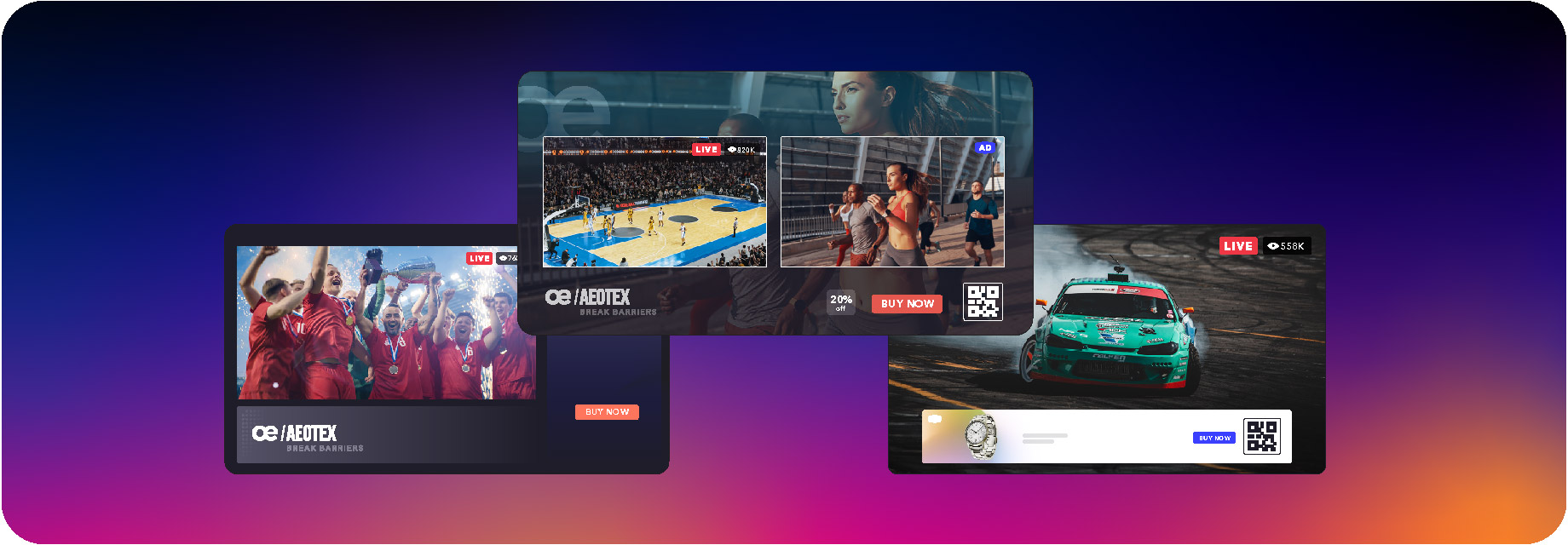
This combination is the point. Personalization produces value because it reduces wasted impressions for local advertisers, improves relevance for national brands, and gives niche publishers a way to raise CPMs without building custom infrastructure or separate streams. When the workflow supports viewer-level variation and the device can handle the render without strain, personalization stops being a theory and starts being a revenue engine.
SGAI Going Forward
Hudl is not a tier one streaming service, and that’s precisely why the example matters. If a distributed, hyperlocal publisher can run personalized campaigns at this scale, the limiting factor was never the size of the publisher. The limiting factor was the ad workflow. SGAI removes that constraint.
For national broadcasters, the value is different but just as direct. SGAI lets the device use its own viewer-level signals for ad requests while keeping the client workload light enough for smart TVs and dongles, sidestepping the data access problem in SSAI and the execution burden in CSAI. Industry deployment is still early, but the pattern is consistent. Live sports, news, and fast-growing CTV environments are adopting SGAI first because they feel the operational limits of legacy architectures most acutely.
After a decade of talking about personalized TV advertising, the barrier was never the data or the targeting logic. It was the architecture. SGAI works because it finally aligns the ad decision with where the signals live and the stream with where stability matters.